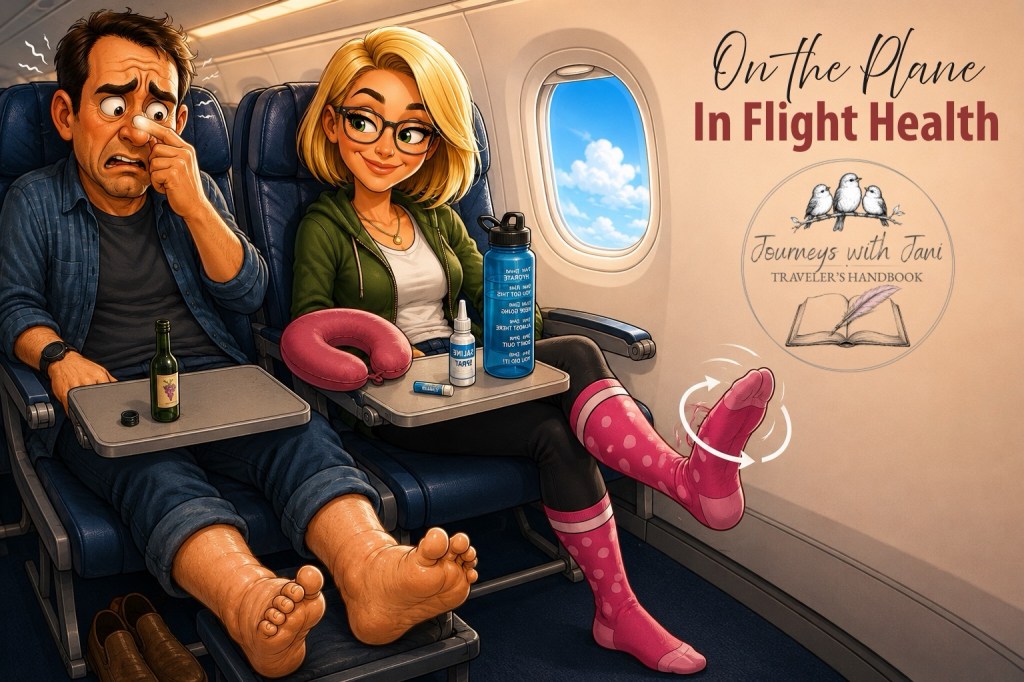
In Flight Health Tips
In 10 Seconds
Your body was not built for a pressurized metal tube at thirty-five thousand feet, and it will let you know. Swollen ankles, screaming ears, a headache you cannot explain, and legs that have forgotten they exist. Almost all of it is preventable with things you can do from your seat. Here is what actually matters in the air, what to pack, and when a symptom deserves more than a glass of water.
You’ll Learn
- Why your body behaves strangely at altitude and what to do about it
- How to keep your legs happy and why it is not just a long haul issue
- The ear and sinus fix that works better than gum
- What to eat and drink, and the one drink that costs you more than it gives
- When to stop troubleshooting and tell a flight attendant
First, What Is Actually Happening Up There
The cabin is pressurized, but not to sea level. On most flights you are effectively sitting at six to eight thousand feet of elevation, somewhere between Denver and a Colorado ski town. Slightly less oxygen reaching your bloodstream. Air that is bone dry. And you are sitting nearly motionless in a small space for hours.
None of that is dangerous for a healthy adult. All of it explains why you feel weird.
That mild headache on hour three is usually altitude plus dehydration. The bloated feeling is trapped gas expanding at lower pressure, which is genuinely what is happening and there is no dignified way to say it. The heavy legs are pooled fluid. The wine that hits you twice as hard is the lower oxygen doing you no favors.
Your Legs Need You to Care
This is the one I will not be light hearted about, because it is the only in flight health issue with real teeth.
Sitting still for hours slows the blood flow in your legs. In most people, nothing comes of it. In some people, a clot can form in a deep vein, and if it travels, it becomes a serious problem. Risk climbs with flights over roughly four hours, and it climbs further with age, recent surgery, pregnancy, hormone therapy, a personal or family history of clots, obesity, smoking, or a cast on your leg.
What actually helps:
Get up. Once an hour on a long flight, even if it is just a lap to the galley and back. If you know you are the kind of person who will not get up, book the aisle and remove the excuse.
Move in your seat. Ankle circles, heel raises, toe raises, knee lifts. Thirty seconds of it every half hour is more valuable than one heroic walk at hour six.
Compression socks on flights over four hours. Graduated compression, meaning tighter at the ankle and looser going up. Not tube socks. Not the ones with an elastic band that bites into your calf. Put them on before you leave the house, not once your feet have already swollen.
Stay hydrated. Thick blood does not move well.
Do not cross your legs for hours. Or sleep with your legs folded under you.
Jani’s Tip If you have had recent surgery, a recent clot, or you are pregnant and past the halfway mark, talk to your doctor before the trip, not the night before. And tell me too. Flight length, layover placement, and even which airline I book can change based on that conversation, and it costs you nothing to have it early.
The Ear and Sinus Situation
Ear pain on descent is not random. Your middle ear needs to equalize with the changing cabin pressure through a narrow tube, and if that tube is swollen from a cold, allergies, or congestion, it cannot keep up. The result ranges from mildly annoying to genuinely brutal.
Chewing gum is the advice everybody gives. It is fine, but it is weak.
What works better:
- Swallow deliberately and often during descent. Sip water continuously.
- The gentle version of the Valsalva maneuver. Pinch your nose, close your mouth, and blow softly, like you are trying to inflate a balloon with almost no effort. Gently. You are equalizing pressure, not proving a point.
- A decongestant taken before takeoff, if you are congested and your doctor is fine with you taking one. Timing matters. Taking it as the plane starts down is too late.
- Saline spray throughout the flight to keep things from drying and swelling.
- Stay awake for descent if your ears are prone to trouble. You cannot equalize while asleep.
For babies and small children, a bottle, a pacifier, or nursing during descent does the same job. They cannot pop their own ears on request.
Jani’s Tip If you fly congested more than once a year, buy a set of filtered pressure regulating ear plugs and keep them in your bag. They slow the rate of pressure change against your eardrum. Ten dollars, reusable, and worth every penny the first time you actually need them.
Eat and Drink Like You Want to Feel Human
Water, constantly. The cabin is drier than most deserts. Bring an empty bottle through security and fill it past the checkpoint, because the cups on board hold roughly four polite sips and the cart comes around when it feels like it.
Alcohol is expensive up here. Not in dollars. Lower oxygen, dry air, and dehydration mean one drink on a plane behaves like more than one on the ground, and it wrecks whatever sleep you were hoping to get. If you want a glass of wine, have it, then chase it with water and stop at one.
Coffee counts against you on the hydration ledger, and onboard hot drinks are made with aircraft tank water, which is a whole separate conversation. Buy it in the terminal.
Eat lighter than you think. Heavy, salty, greasy food plus expanding gas plus swelling equals a rough afternoon. Salt in particular makes the ankle swelling worse.
Bring your own food. Airport food is expensive and airline food is unpredictable, and if you have a real dietary need, hoping the galley has something is not a plan. Protein bars, nuts, a sandwich, fruit that travels well. Skip anything aggressively fragrant. Your seatmates are trapped.
Fizzy drinks and gum both introduce air into a system that is already dealing with expansion. Not a crisis, just something to know if you tend to bloat.
Your Eyes, Skin, and Everything Else That Dries Out
Ten to twenty percent humidity does not care about your skincare routine.
- Contact lens wearers, wear glasses. Or at minimum bring drops and take the lenses out on a long flight. Dry cabin air plus contacts equals gritty, red, miserable eyes.
- Lubricating eye drops in your bag. Not the redness reducing kind, the plain moisturizing kind.
- Lip balm. You will use it more than you expect.
- A face moisturizer or a hydrating mist if you care about how you look on arrival. Nobody has ever regretted this.
- Saline nasal spray again, because a dried out nose is both uncomfortable and less able to filter what you breathe.
Medications, Devices, and Conditions
Keep every medication in your carry on. Never in checked luggage. Bags get delayed, and a delayed bag with your prescriptions in it turns an inconvenience into a real problem.
Keep them in original labeled containers when you can, especially internationally. Bring a copy of the prescription for anything you would struggle to replace.
Set a plan for time zones. Crossing several zones scrambles a medication schedule. For most routine medications a few hours of drift is nothing, but for anything time sensitive, ask your pharmacist how to handle it before you leave. They are very good at this and it takes one phone call.
Diabetes supplies, EpiPens, inhalers, and anything you might need suddenly go in the seatback area or under the seat in front of you, not in the overhead bin. The bin might as well be in another county during turbulence.
If you use supplemental oxygen or a portable oxygen concentrator, airlines require advance notification and only approve specific devices, and the rules vary by carrier. This is a call to make weeks ahead, not days. Let me handle it as part of the booking.
If you have a heart or lung condition, are recovering from surgery, or have any doubt at all, ask your doctor whether you are cleared to fly and at what point. Most people are cleared. The ones who are not usually just need to wait a few weeks. Finding out from your doctor beats finding out from a gate agent.
Motion Sickness
Some people get it, some never do, and there is not much justice in the distribution.
If you are prone to it:
- Sit over the wing. It is the pivot point of the aircraft and the most stable seat in the cabin. A window seat there lets you fix your eyes on the horizon, which helps your brain reconcile what it feels with what it sees.
- Take medication before you board, not after you feel sick. Once nausea starts, most remedies are playing catch up. Note that many of them make you drowsy.
- Ginger, in whatever form you like it. Chews, candies, ginger ale with real ginger. Modest but real.
- Acupressure bands work for some people. Cheap enough to test.
- Cool air on your face from the overhead vent, and something bland in your stomach rather than nothing at all.
Sleep, If You Can Get It
Book the window if sleep is the goal. You get a wall to lean against and nobody climbs over you.
A real neck pillow beats a bad one by a mile. The horseshoe shape that supports your chin, not the flat one that just fills space.
Eye mask and earplugs or noise cancelling headphones. The cabin never actually goes dark and it is never actually quiet.
Layers. Cabin temperature is a rumor. Bring a wrap or a hoodie you can add or remove.
Be careful with sleep aids on a plane. They deepen sleep, which means you sit motionless longer, which is the opposite of what your legs need. If you take something, still get up and move. And never mix a sleep aid with alcohol at altitude.
When to Say Something
Most in flight discomfort is exactly what it looks like. But tell a flight attendant, right away and without apologizing for it, if you or someone near you has:
- Chest pain or pressure
- Trouble breathing or shortness of breath that is not improving
- Sudden severe headache, confusion, or trouble speaking
- Fainting, or feeling like you are about to
- Sudden pain, warmth, or swelling in one leg, especially the calf
- A severe allergic reaction
Crews are trained for medical events, they carry emergency equipment, and they can reach ground based medical support by radio. They would infinitely rather help you at hour two than deal with an emergency at hour five. Nobody has ever been annoyed by a passenger who spoke up.
Quick Reference: In Flight Health Cheat Sheet
The Issue What Causes It What Helps Swollen ankles and feet Fluid pooling, low movement, salt Compression socks, move hourly, ankle circles, less salt Leg clot risk Long stillness plus risk factors Aisle seat, walk hourly, compression, hydrate, doctor’s input Ear pain on descent Congestion blocking equalization Swallow, gentle Valsalva, decongestant before takeoff, stay awake Headache Altitude plus dehydration Water early and often, less alcohol, snack Bloating Gas expanding at lower pressure Lighter meals, skip fizzy drinks, loose waistband Dry eyes Ten to twenty percent humidity Glasses over contacts, lubricating drops Dry nose and throat Same Saline spray, water, lip balm Alcohol hitting hard Less oxygen plus dehydration One drink maximum, water alongside Motion sickness Sensory mismatch Wing seat, medication before boarding, ginger, horizon Bad sleep Noise, light, temperature, seat Window seat, eye mask, real neck pillow, layers
One Last Thing…
None of this is complicated. Water, movement, a small bag of the right supplies, and a little planning for whatever your body specifically does at altitude. Do those four things and you land ready for the trip instead of needing a day to recover from getting there.
That last part matters more than people realize. The whole reason to fly well is so the vacation starts the moment you arrive, not the following afternoon.
And the flight itself is only one piece. Seat choice, layover length, arrival timing, and whether that overnight flight is a brilliant idea or a terrible one for you specifically, those are the decisions that shape how the whole trip feels. That is my job, and I would love to do it for you. Find me at taketimetotravelga.com
XOXO, Jani ~ Personal Travel Advisor | Take Time To Travel, LLC
Updated August 2026
General travel comfort information only. This is not medical advice and I am not a medical professional. If you have a health condition, are pregnant, are recovering from surgery or illness, or take prescription medication, talk with your doctor or pharmacist before you fly.
Related Traveler’s Handbook Articles
On the Plane
Airport Know-How
Before You Go


Leave a Reply