How to Pick the Right Resort for the Trip You Actually Want
In 10 Seconds
“Adults only” is a legally enforced age minimum, not a vibe. If your travel party includes anyone under that number, they will not check in, and no amount of charm at the front desk changes that. “Family friendly” is the opposite problem: it means nothing specific at all, and it covers everything from a resort that quietly tolerates children to one with a four-story waterslide and a foam party at eleven in the morning. Picking correctly is less about who you’re traveling with and more about what you want your mornings to sound like.
There is a particular phone call I get about twice a year, and it always comes in with the same panicked energy.
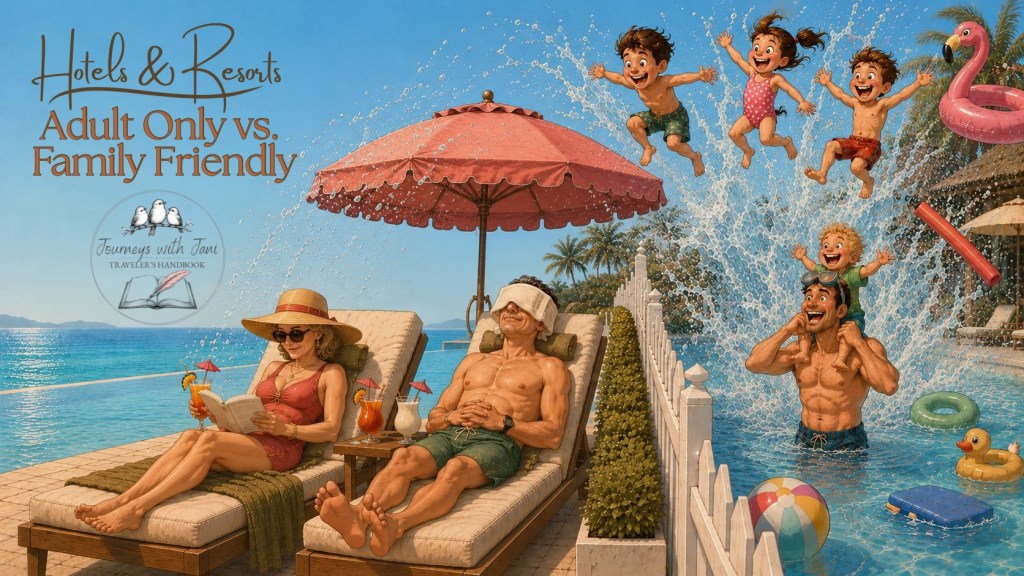
Somebody booked a honeymoon. Somebody booked it themselves, at a good price, at a beautiful property with excellent photos. And somebody is now standing on a pool deck in the Riviera Maya during the second week of spring break, watching a nine-year-old attempt a cannonball roughly four feet from where the mimosas are being served, wondering where exactly the romance portion of this trip is scheduled to begin.
Nobody did anything wrong. The resort was lovely. The rate was fair. The photos were accurate. The only mistake was assuming that “resort” is one product and price is the main thing separating one from another.
It isn’t. The single biggest factor in whether you love a resort or merely tolerate it is who else is standing in the pool with you. So let’s talk about it plainly.
Adults Only Is a Rule, Not a Suggestion
Start here, because this is the part with actual consequences.
When a resort designates itself adults only, that is a contractual, enforced policy. The property has built its entire operation around it: the noise levels, the pool layout, the entertainment schedule, the restaurant hours, sometimes the insurance. They are not going to make an exception because your daughter is very mature for her age or because your seventeen-year-old turns eighteen in six weeks.
The age minimum itself is where people get tripped up, because it is not standardized. The most common cutoff in the Caribbean and Mexico is 18. But I have booked properties that set it at 16, and I have booked properties that set it at 21. A few couples-only resorts don’t just require adults, they require that you arrive as a couple, which is its own separate conversation and one that surprises the woman who wanted to take her sister.
Here’s what that means practically. If you are traveling with a seventeen-year-old, you are not looking at “most adults only resorts with a few exceptions.” You are looking at a genuinely small list, and you need to confirm it in writing before a deposit changes hands. And if that seventeen-year-old has a birthday during the trip, the age on the day of check-in is the one that counts.
Jani’s Tip: Check the age minimum on the specific property, not the brand. Hotel groups run adults-only and family brands side by side, sometimes on the same beach, sometimes literally sharing a lobby. Secrets and Dreams are siblings. Zilara and Ziva are siblings. Sandals and Beaches are siblings. The names are one syllable apart on purpose, and I have watched people book the wrong one.
“Family Friendly” Means Almost Nothing
Now flip it over.
Adults only is a specific claim. Family friendly is marketing language, and it stretches to cover an enormous range of properties that have very little in common with each other.
On one end you have a resort that permits children, has cribs available, and will bring your toddler a plate of plain pasta without making a face about it. Lovely. Quiet. There might be four kids on property in September.
On the other end you have a resort engineered around children the way a casino is engineered around slot machines. Water park. Splash pad. Character breakfast. Kids club with credentialed staff and a real curriculum. Teen lounge with a gaming setup. Poolside activities on a loudspeaker starting at nine in the morning and running until the evening show.
Both of those are honestly, accurately described as “family friendly.” They are also two completely different vacations, and the second one will be miserable for a couple celebrating an anniversary and glorious for a family of five in July.
So the real question isn’t whether children are allowed. It’s how many, and what the resort is doing to entertain them.
How to actually read this before you book:
- Look at the pool count and the pool names. A resort with one main pool and one quiet pool is telling you something. A resort with a “family pool,” an “activity pool,” a “splash zone,” and a “serenity pool” is telling you something very different.
- Find the daily activity schedule. Most resorts post one. If water aerobics, pool volleyball, and a dance contest are stacked before noon, that is a loud property, and the volume is not accidental.
- Read reviews from the month you’re traveling, not the most recent ones. The exact same resort has a different personality in mid-October than it does the week of Easter.
- Check the maximum occupancy per room, not just the bed count. This is the sleeper issue. Plenty of gorgeous properties cap rooms at three people regardless of the sofa bed situation, which quietly turns a family of five into a two-room booking and changes your budget by a third.
The Middle Ground Nobody Talks About
Here’s the part that solves more problems than either extreme, and it is criminally under-discussed: the resort within a resort.
A large number of family properties operate an adults-only section on the same grounds. Separate pool. Separate beach area. Sometimes a separate restaurant, separate check-in, separate bar, and its own concierge. You book that room category, you get a wristband, and you have access to the quiet side while your teenagers have access to everything else.
This is the single best answer for multigenerational travel, and it is the recommendation I make more than almost any other. Grandparents get a peaceful morning. Parents get an adults-only dinner. Kids get a waterslide. Everyone eats together when they feel like it and separately when they don’t, and nobody has to pretend they wanted the same vacation.
It’s also the answer for the couple who wants adults-only energy but is traveling as part of a larger group that includes a family with children. You stay together. You just don’t share a pool deck.
The catch is that these sections vary wildly in how seriously the property enforces the boundary. At a well-run resort, the adults-only area genuinely is. At a lazier one, “adults only” means a sign and a hope. That distinction almost never shows up on the website, and it is exactly the kind of thing I know from sending clients and hearing back.
Who Should Book What
Let me be direct, because this is where people overthink it.
Book adults only if: you’re on a honeymoon, an anniversary trip, a milestone birthday, a girls’ trip, or any trip where the point is to be off duty. Book it if you want dinner at eight-thirty without a reservation battle. Book it if the phrase “silent pool” makes your shoulders drop three inches just reading it.
Book a quiet family-friendly property if: you have kids but you’re not looking for a theme park with a beach attached. You want them fed, safe, and entertained enough, and you’d rather the whole thing feel like a nice hotel than a cruise ship on land.
Book a full family-focused property if: you have children between roughly four and twelve and you would like to sit down for one uninterrupted hour. This is what those resorts are built for and they are genuinely excellent at it. The kids club is not a babysitting closet. At the good ones it’s the highlight of the trip for the children and the reason the parents come home rested.
And a word about teenagers, because they are the forgotten demographic in all of this. Most kids clubs cap out around twelve. Teen programming ranges from a real, well-attended lounge to a ping-pong table in a hallway with a sign on it. A fifteen-year-old at a resort built for small children is bored by day two, and a bored fifteen-year-old is a project. If you’re traveling with teens, teen facilities are the thing to research, not the kids club.
Jani’s Tip: Timing does half the work of the resort designation. A family-friendly property the last week of September feels almost adults only. That same property the week of spring break feels like a school field trip that got out of hand. If your dates are flexible and your budget is tight, traveling outside the school calendar buys you the quiet you were about to pay a premium for.
The Mistakes I See Most Often
Booking adults only for a trip that includes a seventeen-year-old. Covered above, but it bears repeating, because the discovery usually happens at check-in and there is no fixing it at check-in.
Assuming adults only means childless quiet. It means no children. It does not necessarily mean peaceful. Some adults-only properties are built around a party: pool DJs, foam parties, swim-up bars with a serious commitment to volume. That is a wonderful vacation for a bachelorette group and a terrible one for a couple hoping to read on a lounger. Read the resort’s own description of itself. If it uses the word “energy” more than once, believe it.
Forgetting that some destinations have their own norms. Adults-only properties in parts of Europe may be clothing optional at certain pools or beach sections. This is normal and well-signposted where it happens, but it is worth knowing before you get there rather than after.
Booking a wedding group at a property with an age minimum. If you’re planning a destination wedding and any guest is under the cutoff, that decision has to be made before you send a save-the-date, not after. I have seen this go sideways in ways that genuinely hurt feelings.
One Last Thing…
Every single one of the distinctions above is knowable in advance. None of them are secret. They are just scattered across property websites, buried in fine print, contradicted by third-party booking sites, and written in language designed to make every resort sound perfect for everyone.
That’s the actual work of my job. Not finding you a resort, because anyone can find a resort. Knowing which one matches the trip you have in your head, and which one will quietly ruin it.
When you tell me you want a quiet anniversary trip, I’m not scrolling the same photos you already scrolled. I’m thinking about which properties enforce their adult sections, which ones go loud at noon, which ones have a wedding group booked your week, and which room category on which side of the property is going to give you the morning you’re picturing. That knowledge comes from sending real people to real places and hearing what they said when they got home.
If you’re weighing adults only against family friendly right now and the websites are all starting to blur together, let’s talk it through. It costs you nothing to ask, and it is a whole lot cheaper than finding out at the pool.
One page at a time, we’re building a smarter way to travel.
XOXO, Jani ~ Personal Travel Advisor | Take Time To Travel, LLC
Updated August 2026
Resort age policies, room occupancy limits, and adults-only section rules are set by each individual property and change without notice. Always confirm the specific policy for your resort and your travel dates before booking.
Related Traveler’s Handbook Articles
Hotels & Resorts
Before You Go
- Travel Insurance Explained
- Money Matters: Cash, Credit Cards & Foreign Currency
- Travel Documents You Should Always Carry
- Passports Made Simple
- Packing Like a Pro: The Ultimate Packing Guide
People Ask Me This Every Single Week


Leave a Reply