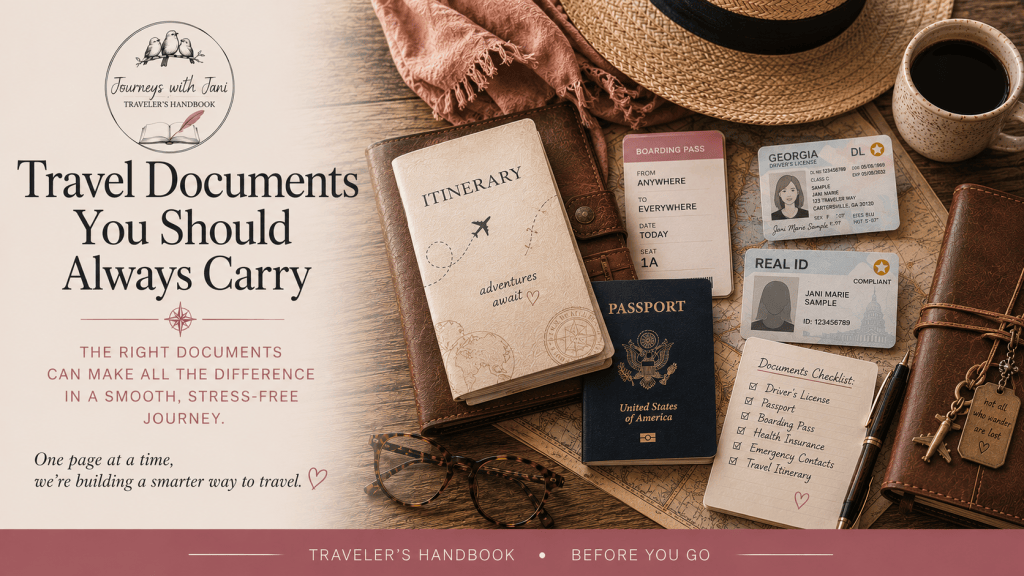
Travel Documents You Should Always Carry
In 10 Seconds
Your suitcase can get lost. Your phone can die. Your documents are the one thing that should never be left to chance. Know what you need, carry it the smart way, and back it up twice. That’s the whole game.
I’ve watched a grown man cry at a check in counter over a passport. Not because it was expired. Because it was sitting on his kitchen counter three states away.
Here’s the thing about travel documents. Nobody thinks about them until the exact moment they need them, and by then it’s usually too late to fix. A missed flight because of a forgotten ID isn’t a funny story. It’s an expensive one.
So let’s talk about what you actually need, where it should live, and how to make sure one bad moment doesn’t turn into one ruined trip.
The Non-Negotiables
These are the documents that get you through the door. Literally.
Government Issued Photo ID
For domestic travel, this means a REAL ID compliant driver’s license or state ID. As of May 2025, TSA requires REAL ID for flying within the United States unless you’re using a passport instead. If your license doesn’t have that little star in the corner, check with your state before you fly. You do not want to find out at security.
Passport
Required for international travel, obviously, but there’s more to it than just having one.
Most countries require your passport to be valid for at least six months beyond your travel dates. Not six months from when you booked the trip. Six months from when you come home.
Some countries also require at least one or two blank pages for stamps. Yes, even in this digital age, plenty of border agents still like their ink.
Check your passport now. Not the week before you leave. I’ve had clients discover an expired passport nine days before departure, and let me tell you, expedited processing is not cheap or guaranteed.
Boarding Passes
Mobile passes work beautifully right up until your phone dies, loses signal, or decides today’s the day it wants to reboot itself in the security line. I always recommend a screenshot as backup, and a printed copy never hurts either.
If You’re Leaving the Country
International travel adds a few more items to your list.
Visas
Not every country requires one, but plenty do, and the rules change more often than you’d think. Some visas need to be arranged weeks in advance. Others can be done on arrival or even online before you leave. Never assume. Look it up for your specific destination and passport, every single time, even if you’ve been there before.
Proof of Onward Travel
Some countries won’t let you in without proof you’re leaving again. A return flight confirmation usually covers it.
Vaccination Records
A handful of countries still require proof of certain vaccinations, yellow fever being the most common one. Check the requirements for your destination well ahead of time, since some vaccines need weeks to become effective.
International Driving Permit
Planning to rent a car overseas? Many countries require an International Driving Permit in addition to your regular license. It’s inexpensive and easy to get through AAA, but it needs to happen before you leave home. You cannot get one abroad.
Jani’s Tip
Take a photo of every important document before you leave the house. Passport, ID, insurance cards, boarding passes, hotel confirmations, all of it. Email the photos to yourself, then also send them to a family member back home. If something goes missing, you’ve got a backup in two places instead of zero.
Documents That Save the Day, Not Just the Trip
Travel Insurance Information
If you’ve got travel insurance, and I hope you do, carry the policy number and the emergency contact line with you, not just in an email you’ll never find when you’re standing in a foreign hospital. I break down what to actually look for in a policy over in Travel Insurance Explained.
TSA PreCheck, Global Entry, or CLEAR Cards
If you’ve got one of these, bring the physical card or know your Known Traveler Number by heart. I walk through all three programs, along with the newer Digital ID option, in TSA PreCheck, Global Entry, CLEAR & Digital ID.
Medical Information
A simple card listing allergies, medications, and any medical conditions can be a genuine lifesaver, especially if you’re traveling alone or somewhere with a language barrier. Keep it with your ID, not buried in a suitcase.
Emergency Contacts
Write down two or three emergency contacts on paper. Not just saved in your phone. If your phone is lost, stolen, or simply dead, you’ll still know who to call and how.
Traveling With Kids
If you’re flying internationally with a minor, and especially if one parent isn’t traveling, bring more than you think you need.
🧑🧑🧒 Birth certificates.
🧑🧑🧒 A notarized consent letter if the other parent isn’t present.
🧑🧑🧒 Custody documentation, if relevant to your situation.
Some countries are strict about this, and border agents have absolutely turned families away over missing paperwork. It’s an uncomfortable conversation to have, but it’s a far more uncomfortable one to have at the border.
Where Your Documents Should Actually Live
This is where most people go wrong. They scatter everything. Passport in one bag. Insurance card in a wallet. Boarding pass on a phone that’s about to die.
Keep your essential documents together in one dedicated pouch or folder. Something you can grab in three seconds flat, not something you have to dig for while a TSA line grows behind you.
Inside that pouch:
- Passport and any visas.
- Driver’s license or ID.
- Printed boarding passes or itinerary.
- Insurance information.
- Emergency contact card.
- Medical information card, if needed.
This pouch goes in your personal item. Never your checked bag. If your suitcase decides to visit a different city than you, your documents should not be riding along with it.
Jani’s Tip
Before you leave, snap a photo of your suitcase and its contents, especially if it’s checked. If it gets lost, the airline will ask exactly what was in it, and “clothes and stuff” doesn’t hold up nearly as well as a photo does.
Digital Backups, Because Life Happens
I’m not anti technology. I use it constantly. But I’ve learned the hard way that relying on a single phone for every important document is a gamble.
Here’s a system that’s saved more than one client’s trip.
💻 Scan or photograph every document before you leave.
💻 Save copies to a cloud drive you can access from any device.
💻 Email copies to yourself and to someone you trust at home.
💻 Keep a printed copy of your passport photo page tucked separately from the passport itself.
If the worst happens and your passport is lost or stolen abroad, having a copy of that photo page will make replacing it at the nearest embassy significantly faster.
Jani’s Ten Document Commandments
1️⃣ Check your passport expiration date the moment you book a trip, not the week before.
2️⃣ Six months of validity beyond your travel dates. No exceptions, no gray area.
3️⃣ Photograph every document before you leave home, then email it to yourself.
4️⃣ Keep essential documents in one pouch in your personal item, never in checked luggage.
5️⃣ A printed boarding pass beats a dead phone battery every time.
6️⃣ Look up visa requirements for every trip, even places you’ve visited before.
7️⃣ Write down emergency contacts on paper, not just in your phone.
8️⃣ If you’re traveling with kids and not both parents, bring the paperwork to prove it.
9️⃣ An International Driving Permit has to happen before you leave. It cannot be fixed abroad.
🔟 If you wouldn’t want to lose it, don’t let it out of arm’s reach.
One Last Thing…
Nobody plans a trip around the idea that something might get lost or forgotten. But a little bit of preparation now means one less thing to worry about later, and it means if something does go sideways, you’ll actually know what to do about it.
Documents aren’t the fun part of travel planning. I get it. Nobody dreams about their passport expiration date the way they dream about the Amalfi Coast. But handling this part right is exactly what lets you relax once you get there.
And that’s really the whole point, isn’t it? Doing the boring work ahead of time so the good part can actually be good.
If figuring out visa requirements and entry rules for your next destination sounds like a headache you’d rather hand off, that’s precisely the kind of thing I take care of for my clients every single day. When you’re ready to plan the trip, I’ll help make sure the paperwork doesn’t stand in the way of it.
XOXO, Jani ❤️
Updated August 2026
Document and entry requirements vary by country and change often. Always verify current passport, visa, and ID requirements with the official government sources for your destination before you travel.
Related Traveler’s Handbook Articles
Before You Go
- Passports Made Simple
- Travel Insurance Explained
- How to Choose the Right Suitcase
- Carry On vs. Checked Bag
- Packing Like a Pro: The Ultimate Packing Guide
Conquering the Airport

 Journeys With Jani: Traveler’s Handbook
Leave a comment