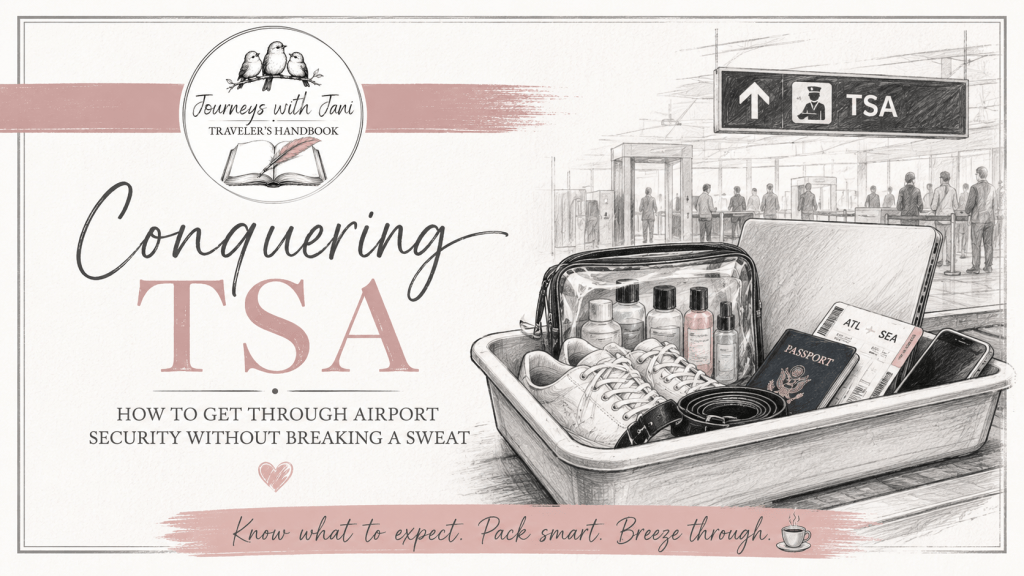
Conquering TSA
In 10 Seconds
TSA isn’t trying to ruin your vacation. They’re trying to keep everyone safe while moving thousands of people through security every hour. If you know what to expect before you step into line, you’ll move through security faster, with less stress, and without becoming “that traveler” everyone behind you is secretly talking about.
You’ll learn:
- What actually happens at TSA
- How to prepare before you reach the checkpoint
- What to remove, and what to leave alone
- The most common mistakes travelers make
- How to get through security like you’ve done it a hundred times
How to Get Through Airport Security Without Breaking a Sweat
There are two kinds of people in an airport security line.
The first person has their ID ready, shoes already untied, laptop easily accessible, and somehow glides through in about two minutes.
The second person reaches the front of the line and suddenly remembers they have a full bottle of shampoo, a laptop buried under six outfits, keys in every pocket, a water bottle clipped to their backpack, enough loose change to finance a small nation, and a full size can of hairspray they will swear under oath they packed in the checked bag.
They did not pack it in the checked bag.
We’ve all been one of those people.
The good news is that getting through TSA isn’t difficult once you understand how the process works. The biggest delays usually aren’t caused by TSA. They’re caused by travelers who simply weren’t prepared.
The goal isn’t to rush.
The goal is to arrive at the scanner already knowing what happens next.
Before You Ever Get in Line
This is where experienced travelers quietly save themselves ten minutes.
Before you even join the security line, step off to the side for a moment and do a quick self check.
Have your government issued ID or passport ready.
Have your boarding pass available, either printed or on your phone.
Empty your pockets before TSA asks.
Throw away that half finished bottle of water.
Put sunglasses, AirPods, chargers, and loose items into your carry on instead of juggling them in your hands.
If you’re traveling with children, take a deep breath. TSA officers see families every single day. No one expects perfection.
Dress for Security, Not for a Fashion Show
Believe it or not, what you wear can affect how quickly you get through security.
Shoes that lace halfway up your legs might look adorable. You’ll feel differently while twenty people wait behind you.
Simple sneakers are your friend.
Wear as little metal as possible.
Large belt buckles, stacks of bracelets, oversized jewelry, heavy watches, and clothing loaded with metal embellishments all increase the chances of additional screening.
Comfort wins every single time on travel day.
Know Your Carry On
Most TSA slowdowns happen because something inside a bag can’t easily be screened.
Before you leave home, pack with security in mind.
Keep your electronics where you can reach them.
Know where your liquids are.
Don’t bury medications under three days’ worth of clothes.
If TSA needs to inspect your bag, you’ll appreciate knowing exactly where everything is.
Think of your carry on like a well organized kitchen drawer instead of your junk drawer at home.
Future You will be grateful.
What Actually Happens at the Checkpoint
Now you’ve reached the front of the line.
This is where people either look like seasoned travelers or contestants on a game show they forgot to study for.
The good news? TSA follows the same basic routine every day. Once you’ve been through it a few times, you’ll realize there’s a rhythm to it.
Step One, ID Check
You’ll first show your government issued photo ID or passport along with your boarding pass if requested.
Many airports now use facial recognition technology. If yours does, the TSA officer may simply ask you to look at a camera for a moment while the system verifies your identity.
Once you’re cleared, it’s time for the bins.
Step Two, The Gray Bin Ballet
This is where preparation pays off.
Depending on the airport and whether you have TSA PreCheck, you’ll likely place several items into the gray bins.
Typically those include:
- Shoes
- Jackets or coats
- Belts
- Your carry on liquids bag, if required
- Large electronics like laptops, unless the airport has newer scanners that allow them to remain inside your bag
- Anything in your pockets
- If it jingles, rattles, or could fly out while your bin is moving, it belongs in the bin
Jani’s Tip
I still laugh about the first time my oldest son went through TSA. Bless his heart. He wore cowboy boots, a belt, a ball cap, sunglasses, keys in every pocket, and enough loose change to buy a biscuit. Watching him remove one thing after another while everyone behind him waited was equal parts painful and hilarious. We still tease him about it. Learn from his experience. Less is definitely more on travel day.
Step Three, Walking Through the Scanner
Most travelers today walk through either a standard metal detector or an Advanced Imaging Technology scanner.
The scanner isn’t taking your picture.
It doesn’t store your image.
It simply checks for objects that shouldn’t be there.
The officer will ask you to step inside, place your feet on the markers, raise your arms for just a couple of seconds, and then step out.
That’s it.
If everything looks good, you’re on your way.
What If the Alarm Goes Off?
🔥 Don’t panic.
🔥 Seriously.
🔥 This happens far more often than you think.
🔥 Maybe your watch was forgotten.
🔥 Maybe your hoodie zipper triggered the scanner.
🔥 Maybe your jeans have decorative rivets.
🔥 Sometimes it’s simply random screening.
If the machine alerts, a TSA officer will explain exactly what they need to do next. It may be as simple as checking a pocket, rescanning you, or performing a brief pat down.
🥰 It isn’t personal.
🥰 It isn’t punishment.
🥰 It’s simply part of the screening process.
If Your Bag Gets Pulled Aside
Watching your carry on disappear onto the inspection table can make your heart skip a beat.
Take another deep breath.
Most inspections are completely routine.
A charger wrapped around another charger can look unusual on an X ray.
A large bag of trail mix might resemble something that needs a closer look.
And then there’s peanut butter.
Yes, peanut butter. As far as TSA is concerned, it is a gel, not a food, and it gets treated accordingly. I did not make this rule. I have not tried to argue with an officer about the chemical properties of peanut butter, but I have watched someone else try. He did not win. The peanut butter did not win either. Everybody just went their separate ways a little wiser.
Moral of the story, if it’s spreadable, squeezable, or jiggles when you shake it, TSA sees a gel, not a snack.
The officer will usually ask if the bag belongs to you before opening it.
Stay nearby.
Answer any questions.
Within a few minutes, you’ll usually be zipping it back up and heading to your gate.
Don’t Rush to Repack
One of the biggest mistakes travelers make is trying to reorganize their entire suitcase while standing at the end of the conveyor belt.
Grab your bins.
Move to one of the nearby benches or tables.
Then take your time putting your shoes back on, finding your sunglasses, and convincing your belt to cooperate.
Everyone behind you will silently thank you.
Remember
TSA officers aren’t grading your performance.
They’re simply doing the same job hundreds of times a day.
Smile.
Listen.
Follow directions.
Before you know it, you’ll be gathering your things and thinking, “That wasn’t nearly as bad as I remembered.”
Travel Like a Pro
By now you’ve made it through the checkpoint, gathered your belongings, and hopefully resisted the urge to leave your shoes in one bin and your dignity in another.
There are just a few more things every traveler should know before you declare yourself a TSA expert.
Traveling with Medications
One of the questions I hear most often is, “Can I bring my medication?”
Almost always, the answer is yes.
Prescription medications can be packed in your carry on, and honestly, they should be. Never place important medications in a checked suitcase. If your luggage takes an unexpected vacation without you, you’ll still have what you need.
You do not have to place prescription medications in a clear liquids bag.
Liquid medications are also permitted, even if they exceed the standard 3.4 ounce limit. Simply let the TSA officer know before your bags are screened. They may require additional screening, but they’re absolutely allowed.
If you use injectable medications like insulin or GLP1 medications, such as Ozempic, Wegovy, Mounjaro, or Zepbound, you may also bring your needles, pens, and supplies. Again, just keep them together and easily accessible.
Jani’s Tip
As someone who lives with Multiple Sclerosis, I know firsthand that traveling with medications can feel intimidating the first time. It doesn’t have to be. Keep everything together, know where it is, and don’t be afraid to tell the TSA officer if you have a medical need. They do this every single day.
Medical Devices
CPAP machines, mobility aids, walkers, wheelchairs, hearing devices, and many other medical necessities are all allowed through TSA.
If your CPAP needs to be removed from its case for screening, consider packing it in a protective cover or bringing a large clear plastic bag. That way it doesn’t sit directly in the screening bin.
Traveling with oxygen or specialized medical equipment? Check with your airline before travel. Airline policies can differ, even when TSA rules remain the same.
Traveling with Babies
Parents, take a deep breath.
TSA knows babies aren’t exactly known for following airport procedures.
Formula, breast milk, toddler drinks, baby food, and ice packs used to keep them cold are permitted in reasonable quantities, even when they exceed the normal liquid limits.
Just let the TSA officer know before screening begins.
Strollers and car seats will be screened separately.
You may be asked to remove your child from the stroller while it goes through the scanner.
What Happens If You Accidentally Bring Something You Shouldn’t?
It happens.
Every.
Single.
Day.
Maybe you forgot a pocketknife from last weekend.
Maybe your favorite scissors have been living in your backpack for months.
Maybe you completely forgot about the oversized bottle of sunscreen.
Realistically, most confiscated items aren’t dramatic. They’re nail clippers. They’re a corkscrew you swiped from a hotel room in 2019 and never took back out of your bag. They’re a tiny travel scissor you keep meaning to move to your checked bag and never do. Nobody’s smuggling anything. Everybody’s just a little forgetful.
If TSA finds a prohibited item, you generally have several options.
You may return it to your vehicle if you have time.
You may give it to someone who is not traveling.
Some airports have mailing services where you can ship the item home.
Or, if none of those options work, you’ll have to surrender it.
One forgotten pocketknife isn’t worth missing your flight.
TSA Pro Moves
These little habits can make your airport experience noticeably smoother.
Wear shoes that slip on and off easily.
Keep your phone, ID, and boarding pass together in one place.
Empty your pockets before you reach the conveyor belt.
Wait until you’re at a nearby bench before reorganizing your bags.
Refill your water bottle after security instead of carrying one into the checkpoint.
Keep a light jacket handy. Airports and airplanes seem to have a secret competition to see who can keep the thermostat the coldest.
Be patient.
A smile goes farther than you might think.
The Bottom Line
Most travelers spend far more time worrying about TSA than actually going through it.
The reality is that airport security usually takes only a few minutes when you arrive prepared.
Know the rules.
Pack smart.
Listen to the officers.
Take a breath.
Before long, you’ll be walking toward your gate wondering why TSA ever seemed so intimidating in the first place.
Because here’s the truth.
TSA isn’t the beginning of your vacation.
It’s simply the doorway to it.
One Last Thing…
Every experienced traveler was once the person standing barefoot at the scanner wondering where they put their driver’s license. Experience doesn’t come from never making mistakes. It comes from making them once, laughing about them later, and knowing exactly what to do the next time. And if the idea of figuring all of this out on your own makes you tired before you’ve even packed, that’s exactly what I’m here for. Let’s plan a trip where the only thing you have to worry about is which shoes slip off easiest.
XOXO, Jani ❤️
Updated August 2026. This post is for general travel guidance and reflects TSA procedures at the time of writing. Always confirm current requirements with TSA.gov or your airline before you travel.
Related Traveler’s Handbook Articles
Before You Go


Leave a Reply