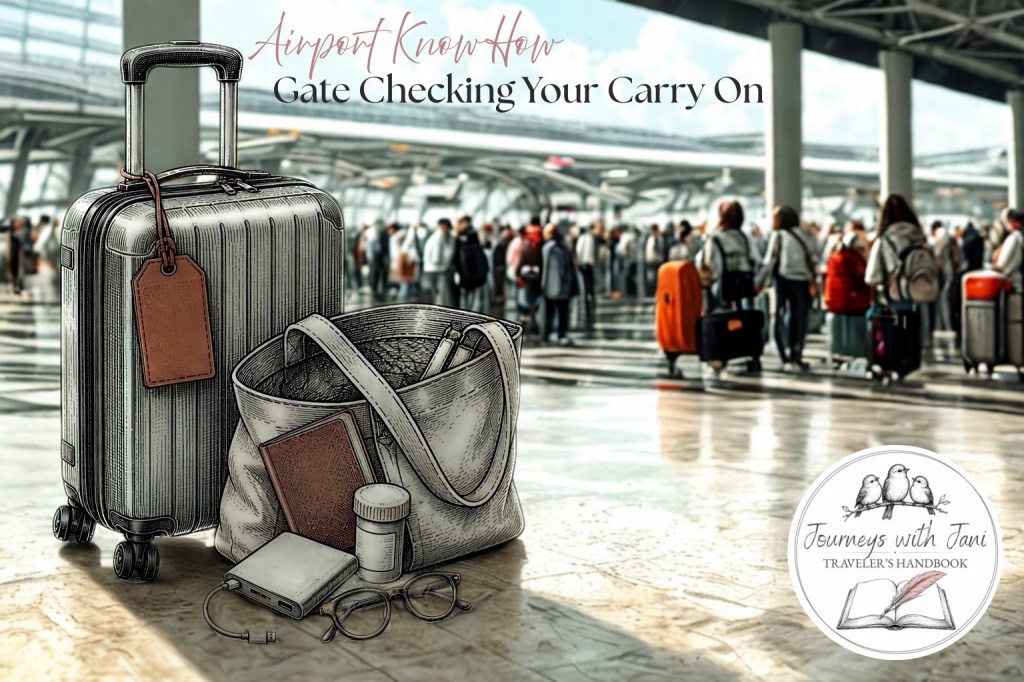
Airport Know-How
In 10 Seconds
There are two completely different things called gate check, and knowing which one you’re getting is the whole ballgame. One hands your bag back at the jet bridge in three minutes. The other sends it to baggage claim in another city. Ask which one, out loud, before you let go of the handle. Then take sixty seconds to pull out your medications, your documents, and every battery you own, because the FAA says the batteries have to come out anyway and the rest of it you’ll want if the bag and you get separated.
You’ll learn:
- The one question to ask before you hand the bag over
- What the FAA requires you to remove, every single time
- When gate check is free and when it quietly costs you
- What the airline owes you if your gate-checked bag never shows up
- The sixty second triage that turns a bad moment into a nothing moment
Nobody Plans For This Moment
You’re in line, you’ve got your bag, you’re fine. Then the gate agent picks up the microphone: “This is a full flight and we are out of overhead bin space.”
And suddenly there’s a decision to make, in a hallway, with people behind you, in about eleven seconds.
Most travelers hand the bag over on autopilot and figure it out later. Later is when they discover the prescription they needed was in it, or that the bag they expected on the jet bridge went to baggage claim, or that “free” gate check turned into a forty dollar charge because of when they were asked.
None of that has to happen. It just requires knowing what’s actually going on.
The Two Kinds of Gate Check, and Why It Matters So Much
They sound identical at the podium. They are not.
Planeside, also called valet. Your bag rides in the belly, and a ramp agent brings it back up to the jet bridge the moment you land. You step off the airplane, wait two or three minutes at the top of the ramp, and there it is. This is what happens on regional jets, and it’s fast enough that plenty of frequent flyers actually prefer it.
Gate check into the system. Your bag is tagged like any other checked bag and it goes to baggage claim in your destination city, along the same carousel as everybody else’s suitcases.
Now imagine you’ve got a connection in forty minutes and you assumed it was coming back at the jet bridge. It isn’t. It’s going to your final destination, which is fine, or it’s sitting at the carousel in the connecting city, which is not fine at all.
So ask. Out loud. Every time. “Will I get this back at the jet bridge, or is it going to baggage claim?” Nine words. Say them before your hand leaves the handle.
If you’re connecting, ask the follow-up too: “Is it tagged to my final destination or just to this next stop?” Agents answer this all day and nobody minds. What they mind is the person who didn’t ask and then wants a supervisor.
The Sixty Second Triage
Before you let go of that bag, open it and pull things out. This is not optional and it is not paranoia. Part of it is federal rule and part of it is just hard-won sense.
What the FAA requires you to remove:
Spare lithium batteries, power banks, portable chargers, e-cigarettes, and vaping devices must come out of any bag that gets checked at the gate or planeside. They have to stay with you in the cabin. This is not an airline preference, it’s the rule, and the reason is that a battery having a bad day is manageable in a cabin with a crew and a fire containment bag, and unmanageable in a cargo hold where nobody is standing.
If you’ve got smart luggage with a built-in battery, it has to come out too. If it can’t be removed, most airlines won’t accept the bag at all.
What you should remove because you’ll regret it otherwise:
- Prescription medications, all of them, in their labeled bottles
- Passport, ID, boarding pass, any travel documents
- House keys and car keys
- Reading glasses and a spare pair of contacts
- Jewelry, cash, and anything genuinely valuable
- Your phone charging cable, because the airplane has USB ports and your bag doesn’t
- Anything fragile, breakable, or irreplaceable
That’s the list. Keep a packable tote or a zip pouch in your bag specifically so you have something to sweep all this into when the moment comes. Sixty seconds at the gate is nothing. Landing in Denver with your blood pressure medication in the belly of an airplane bound for Seattle is a genuinely bad night.
Jani’s Tip
Build your personal item as the “if we get separated” bag from the very beginning and this whole scramble disappears. Medications, documents, batteries, chargers, glasses, and one clean shirt live down there under the seat from the moment you pack. Then when the gate agent asks, you hand the roller over without opening it, walk on board, and everything you actually need is already at your feet. I’ve had clients tell me this one habit was the single most useful thing I ever gave them.
Free, or Not Free?
Here’s the part that catches people, and it’s about timing more than anything.
Usually free: when the airline runs out of bin space and asks for bags. That’s their operational problem, not your mistake, and they generally take the bag at no charge. Same with regional jets, where a standard roller physically will not fit in the bin. That valet tag is free and routine.
Usually not free: when your bag was clearly too big to begin with, and the agent catches it before boarding. That’s treated as a checked bag, and you’ll pay the checked bag fee at the podium. Budget carriers are strictest about this and the gate price is always higher than the online price.
Worth knowing: enforcement is genuinely in flux right now. Some carriers have pulled the metal sizer cages from their gates, some are testing automated scanners, and gate agent discretion varies more than it used to. Don’t build a plan around getting waved through. Measure your bag at home, with the wheels and the handle included, and you never have to think about it again.
Should You Volunteer?
Often, yes. When they announce they’re looking for volunteers, being early in that line is usually the smart play. It’s free, the bin was going to fill anyway, you board with your hands free, and the gate agent remembers who was pleasant about it.
Volunteer when: you’re not connecting, you’ve got a personal item with your essentials in it, and nothing fragile or irreplaceable is in the bag.
Hold onto it when: you have a tight connection and the bag is going to baggage claim, there’s something in it you can’t be without, or you’re flying an itinerary where a delay means an overnight and that bag is your overnight.
And if you’re told to check it and you genuinely can’t, say so plainly and early. “I have medication in this bag” is a sentence that gets you thirty seconds to open it, not an argument.
If Something Goes Wrong
Photograph the bag before you hand it over. Ten seconds, one picture, all four sides if it’s a nice bag. It costs you nothing and it’s the entire difference between a damage claim and a conversation about whether that scuff was already there.
Keep the claim stub. Whatever tag they hand you, hold onto it like a boarding pass.
If it doesn’t come back at the jet bridge, do not walk away. Bags occasionally get sent down to the carousel by mistake. Ask the crew, ask the gate agent, but do it right there before you leave the area.
If it’s damaged or missing, report it before you leave the airport. This is the single most expensive mistake travelers make, and it’s the same rule that applies to any checked bag. Walking out of the building without a file reference number makes your claim dramatically harder.
And here’s the reassuring part. A gate-checked bag is treated as checked baggage for liability purposes. On domestic U.S. flights the airline’s maximum liability is currently $4,700 per passenger for proven loss, delay, or damage. On most international itineraries it’s governed by the Montreal Convention, currently 1,519 Special Drawing Rights per passenger, roughly $2,175. You’re not out in the cold just because the bag started as a carry-on.
Jani’s Tip
Slip an AirTag or a Tile into any bag that might get gate-checked. It costs about thirty dollars and it changes the entire conversation. Instead of “I don’t know where my bag is,” you’re standing at the service desk saying “it’s still at the airport in Charlotte.” Agents move faster when you can tell them where to look, and you spend the wait knowing rather than wondering.
The Short Version
- Ask out loud: jet bridge or baggage claim?
- If connecting, ask where it’s tagged to
- Pull every battery, power bank, and vape out, the FAA requires it
- Pull medications, documents, keys, glasses, and valuables
- Photograph the bag, keep the claim stub
- Volunteer early when you’re not connecting
- Report any damage or loss before you leave the airport
One Last Thing…
Gate checking a bag is not a disaster. It’s a two minute transaction that goes badly only when nobody told you what questions to ask. Now somebody has.
The travelers who move through this smoothly aren’t lucky. They packed a personal item that could carry them through a night without the other bag, and they asked one question at the podium. That’s it. That’s the whole trick.
And if you’d rather have somebody in your corner who already knows which of your flights is on a regional jet with bins too small for your roller, and who picks up the phone when something goes sideways at the airport, that’s what I do. When you’re ready to plan the trip, let’s plan it together.
One page at a time, we’re building a smarter way to travel.
XOXO, Jani ~ Personal Travel Advisor | Take Time To Travel, LLC
Updated August 2026
Baggage liability limits, fees, and airline gate check procedures change periodically. Always confirm current baggage rules and battery restrictions with your airline and with FAA.gov before you travel.
Related Traveler’s Handbook Articles
Airport Know-How
- Lost Luggage: Now What?
- Connecting Flights Without Panic
- Conquering TSA
- TSA PreCheck, Global Entry, CLEAR & Digital ID
On the Plane
People Ask Me This Every Single Week
- Travel Electronics & Chargers Made Simple
- How Early Should I Get To The Airport?
- Traveling With Prescription Medications
Before You Go


Leave a Reply