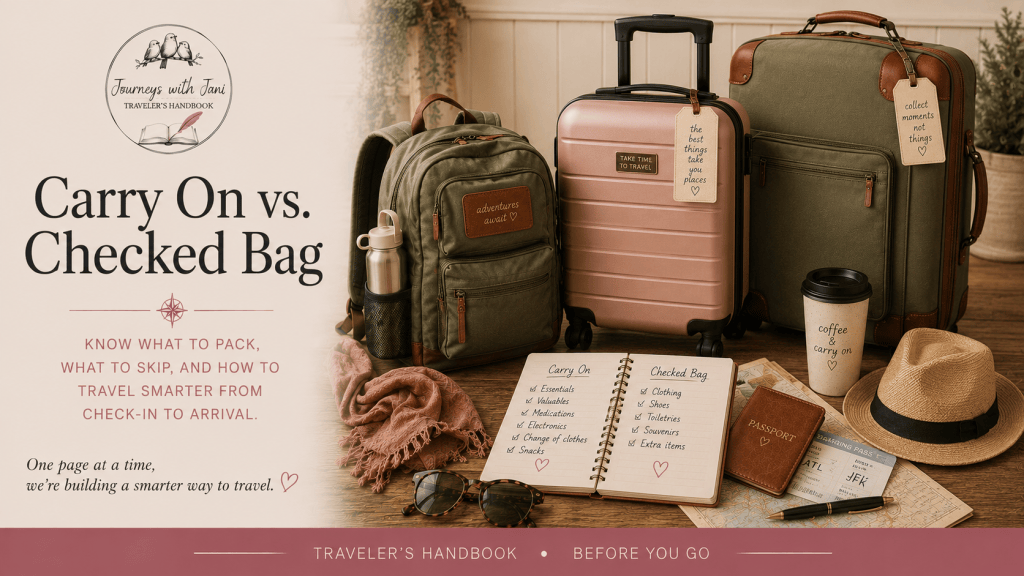
Carry On vs. Checked Bag: What to Pack Where, What It Costs, and How to Avoid Airport Surprises
In 10 Seconds
Trying to decide whether to carry your luggage onboard or check it? There isn’t one right answer.
A carry-on saves time, avoids baggage claim, and keeps your important belongings with you.
A checked bag gives you more room, fewer packing headaches, and less to drag through the airport.
The best choice depends on your trip, your airline, and what you’re bringing.
Carry On vs. Checked Bag
If you’ve ever stood in your bedroom surrounded by piles of clothes thinking, “Surely I need all of this,” you’re in good company. One of the biggest travel decisions actually happens before you ever leave the house.
Do you carry everything onboard?
Or do you check a suitcase?
There isn’t a perfect answer because every trip is different. A weekend in Charleston doesn’t require the same packing strategy as two weeks in Europe or a cruise through Alaska.
Let’s break it down in plain English.
First Things First
What is a Carry-On?
A carry-on is your suitcase or travel bag that travels with you inside the airplane. It goes in the overhead bin above your seat.
Most U.S. airlines allow one carry-on plus one personal item. Your personal item is something smaller that fits underneath the seat in front of you.
Examples include:
A purse
A backpack
A laptop bag
A small tote
A camera bag
Think of your personal item as your “everything I need during the flight” bag.
What is a Checked Bag?
A checked bag is handed over to the airline before security. It rides underneath the aircraft and you’ll pick it up after landing at baggage claim.
Checked bags are usually larger and can hold much more clothing, shoes, souvenirs, and bulky items. The downside? You won’t see it again until your destination.
So…Which One Should You Choose?
That depends.
A Carry-On is Great If…
You’re traveling for three to five days.
You don’t mind wearing a few outfits more than once.
You like getting off the plane and heading straight to your hotel.
You have a tight connection.
You’re worried about delayed luggage.
You simply hate waiting at baggage claim.
Many experienced travelers rarely check luggage anymore because it saves both time and stress.
Checked Bags Make More Sense If…
You’re taking a longer vacation.
You’re packing bulky clothes like coats or boots.
You’re traveling with children.
You’re bringing sports equipment.
You’re cruising.
You’re attending a wedding.
You simply don’t want to play suitcase Tetris every morning.
Sometimes paying the baggage fee is worth every penny simply because your vacation starts with less stress.
Jani’s Tip ☕
Don’t make packing a contest. I’ve watched travelers proudly squeeze everything into one tiny suitcase…only to spend half their vacation wishing they’d packed one more pair of shoes, a jacket, or actual pajamas.
Travel is supposed to be fun.
Pack smart, not miserably.
Airline Rules, Baggage Fees, and Choosing the Best Option
Now comes the part that makes travelers want to pull their hair out.
There is no single baggage rule.
Every airline makes its own rules. Even within the same airline, your baggage allowance can change depending on the fare you purchased, your destination, your frequent flyer status, or whether you hold one of their credit cards.
That’s why one of the most important things you can do before leaving home is spend two minutes checking your airline’s baggage policy.
It can save you a lot of money, and a very awkward moment at the check-in counter.
Not All Tickets Include the Same Bags
Years ago, buying an airline ticket was pretty straightforward. Today, airlines sell several different fare types, and each comes with its own baggage rules.
A Basic Economy ticket might not include a standard carry-on at all. On some airlines, you’re only allowed a personal item that fits under the seat.
A Main Cabin or Economy ticket usually includes one carry-on and one personal item.
Premium cabins often include one or more checked bags at no additional charge.
The lesson? Don’t assume your neighbor’s ticket includes the same baggage allowance as yours.
Carry-On Doesn’t Always Mean Free
One of the biggest travel myths is that carrying your luggage onboard automatically saves money.
Sometimes it does. Sometimes it doesn’t.
Many airlines include a carry-on with your fare. Others charge for it. Some discount airlines actually charge less to check a bag in advance than they do to bring a larger carry-on onboard.
It all depends on the airline.
That’s another reason to check before packing.
International Flights Play by Different Rules
If you’re flying internationally, especially on airlines outside the United States, be prepared for stricter baggage rules. Many international carriers have lower weight limits for carry-ons.
That beautiful rolling suitcase you’ve carried all over the country may suddenly be too heavy before you’ve even packed your shoes.
Some airlines weigh every carry-on at check-in or even at the gate. If it’s overweight, you’ll likely have to check it, and pay the fee.
That’s not the kind of souvenir anyone wants.
The Hidden Cost of Overpacking
An overweight suitcase can get expensive in a hurry.
Many airlines charge additional fees when checked bags exceed their weight limit. Those fees can be surprisingly high, especially on international flights.
If you’re planning to shop while you’re away, leave yourself a little extra room before you leave home.
Your future self, standing in an airport trying to zip a suitcase full of local treasures, will thank you.
What About Connecting Flights?
If you have a very short connection, carrying your bag can sometimes work in your favor. You can head straight to your next gate without worrying about whether your suitcase made the connection.
On the other hand, if you’re checking your luggage on one ticket, the airline usually transfers it to your next flight automatically.
The important word there is usually.
If you’re traveling on separate airline tickets, or switching between unrelated airlines, you may need to collect your luggage and check it again yourself.
Always ask if you’re unsure.
Jani’s Tip ☕
If you’re trying to decide between checking a bag or squeezing everything into a carry-on just to avoid a baggage fee, ask yourself one question:
“Is the money I’m saving worth the hassle I’m creating?”
Sometimes the answer is yes. Sometimes spending a little extra means you arrive relaxed instead of wrestling a stuffed suitcase through three airports, two escalators, and one overhead bin that’s somehow already full.
Because vacations should begin with excitement, not an upper body workout.
What Goes Where
You have decided whether to carry on, check a bag, or use a little of both.
Now comes the more important question:
What belongs in each one?
A checked suitcase should hold the things you can temporarily live without. Your carry-on and personal item should hold the things you cannot.
That sounds simple enough, but every day travelers hand over medications, passports, car keys, expensive jewelry, and every clean pair of underwear they own, then watch their suitcase disappear down a conveyor belt with the confidence of people who have never been betrayed by machinery.
Let us not do that.
What Should Always Stay With You
Your most important belongings should remain in your carry-on or personal item.
That includes:
Your passport or other identification
Your wallet and credit cards
Prescription medications
Glasses and contact lenses
Keys
Jewelry and valuable items
Phones, tablets, laptops, and cameras
Chargers and power banks
Travel documents and cruise documents
Anything sentimental or impossible to replace
One complete change of clothes
Essential toiletries that meet TSA requirements
If losing an item would ruin your trip, create an emergency, or make you cry in the middle of an airport, do not put it in your checked bag.
Never Pack Medication You Need in a Checked Bag
Prescription medications should travel with you. Checked luggage can be delayed, misdirected, or occasionally lost. You do not want your daily medication taking an unexpected side trip while you are standing at your destination trying to explain the situation to a pharmacist.
TSA permits medications in both carry-on and checked bags, but carrying them with you is the safer choice. Medically necessary liquids can also be carried in quantities larger than the usual 3.4 ounce limit, although you should tell the TSA officer about them before screening begins. (TSA)
Whenever possible, keep medications in their original labeled containers and bring enough for your trip, plus a little extra in case your return is delayed.
International travelers should also verify that their medications are legal at their destination. A medication that is perfectly ordinary at home may be restricted somewhere else.
Remember the TSA Liquids Rule
For most liquids, gels, creams, aerosols, and pastes in a carry-on, each container must be 3.4 ounces or smaller.
Those containers must fit inside one quart sized clear bag.
This includes more than beverages. Toothpaste, sunscreen, lotion, liquid foundation, mascara, hair products, peanut butter, and anything else that spreads, sprays, pours, pumps, or squishes may count toward the liquids rule. (TSA)
Full sized toiletries can usually travel in checked luggage, subject to airline, FAA, and destination restrictions.
Jani’s Tip ☕
Do not trust the amount left inside the container.
If the bottle holds eight ounces but only has one ounce of shampoo remaining, TSA still sees an eight ounce container. They are judging the bottle, not conducting a shampoo census.
Power Banks and Spare Batteries Stay in the Cabin
Portable chargers, power banks, and spare lithium batteries cannot go in checked baggage.
They must remain in the airplane cabin with you. Battery terminals should also be protected so they cannot short circuit. If your carry-on is taken from you and gate-checked, remove all power banks and spare lithium batteries before handing over the bag. (Federal Aviation Administration)
Battery powered devices such as phones, cameras, tablets, and laptops are best kept in your carry-on too.
Some devices with installed batteries may be permitted in checked baggage, but they must be completely powered off and protected from damage or accidental activation. Airline restrictions can vary, so check before packing anything unusual or particularly powerful. (Federal Aviation Administration)
Damaged, swollen, or recalled batteries should not travel in either bag unless the battery has been removed or made safe according to current rules. (Federal Aviation Administration)
What About AirTags and Luggage Trackers?
A luggage tracker can give you useful information when a checked suitcase is delayed. It can show whether your bag is still at your departure airport, has arrived at your destination, or has apparently decided to begin a new life in Cleveland.
Small baggage tracking devices may be allowed in checked luggage when they meet federal battery limits, but travelers should still confirm the current policy with their airline. (Federal Aviation Administration)
A tracker does not prevent luggage from being delayed, and it does not replace an airline baggage report. It simply gives you another way to keep an eye on the situation.
What Belongs in Your Checked Bag?
Your checked suitcase is the better place for:
Full sized toiletries
Bulky clothing
Extra shoes
Larger quantities of liquids
Sharp grooming items that are not allowed through the checkpoint
Certain sports equipment
Items that are permitted to fly but cannot go in the aircraft cabin
Before packing anything questionable, use TSA’s official What Can I Bring? search tool. Rules can depend on the item, how it is packed, and whether it contains a battery, fuel, compressed gas, alcohol, or another restricted material. (TSA)
The TSA officer at the checkpoint has the final say over whether an item may pass through security.
Pack for the Possibility of Delayed Luggage
Most checked bags arrive exactly where they should. But “most” is not quite as comforting when yours is the one missing. Your carry-on should include enough to get you through at least the first day of your trip.
Pack:
One complete outfit
Underwear and socks
Sleepwear if space allows
Necessary medications
A toothbrush and basic toiletries
A swimsuit if you are heading to a resort or cruise
Anything required for an event occurring soon after arrival
If you are flying to a wedding, do not check the only outfit you can wear to the wedding.
If you are boarding a cruise, keep your passport, cruise documents, medication, swimsuit, sunscreen, and anything you need during your first afternoon with you. Checked cruise luggage may not reach your cabin immediately.
If you are traveling as a couple or family and checking more than one bag, divide everyone’s clothing between the suitcases.
That way, one delayed bag does not leave one person fully dressed and another wearing airport clothes for three days.
Marriage has survived many things. It does not need that test.
Photograph Your Bags Before You Leave
Take a quick photograph of the outside of each checked suitcase. Then take one of the contents before you close it.
Keep your baggage claim receipt until the suitcase is back in your hands.
These simple steps can make it easier to describe the bag, document what was inside, and file a claim if something goes wrong. Place your contact information inside the suitcase as well as on the outside luggage tag. Use your phone number and email address. Avoid displaying more personal information than necessary.
Do Not Overstuff Your Carry-On
A bag that technically meets the airline’s measurements can still become a problem if it is bulging beyond recognition.
Zippers break.
Wheels snap.
Compartments refuse to close.
And you may be required to place it in a sizing frame at the gate.
Leave a little breathing room, especially if you plan to buy anything during the trip.
Your return flight should not begin with you sitting on a suitcase while your spouse attempts to close it using prayer, brute force, and language unsuitable for the Traveler’s Handbook.
When Your Carry-On Gets Gate-Checked
Even when your ticket includes a carry-on, overhead bin space is not guaranteed. On a full flight, passengers boarding later may be asked to check rolling bags at the gate.
Before handing yours over, remove:
Medication
Identification and travel documents
Keys
Money and valuables
Electronics
Power banks
Spare batteries
Anything fragile
A small foldable tote kept inside your carry-on makes this much easier. You can quickly move your essentials into the tote and keep them underneath the seat.
The Bottom Line
Checked luggage is not bad.
Carry-on luggage is not automatically better.
The smartest approach is often a combination of the two.
Check the bulky, replaceable items.
Carry the important, valuable, medically necessary, and time sensitive ones.
Pack as though your checked suitcase will arrive with you, but prepare as though it might need another day to catch up.
That is not pessimism.
That is travel planning with a clean pair of underwear.
One Last Thing… ☕
Before leaving home, ask yourself:
Could I begin this trip without anything inside my checked suitcase?
You do not need enough supplies to live indefinitely at Gate B17. You need your documents, medication, valuables, electronics, and enough essentials to get through the first day without panic. Pack those things with you, hand over the rest, and go enjoy your trip.
XOXO, Jani
Updated July 2026
Airline baggage policies, fees, carry-on sizes, and weight limits can change at any time. Always verify the current rules with your airline before you travel.
Related Traveler’s Handbook Articles
Before You Go
Conquering the Airport


Leave a Reply