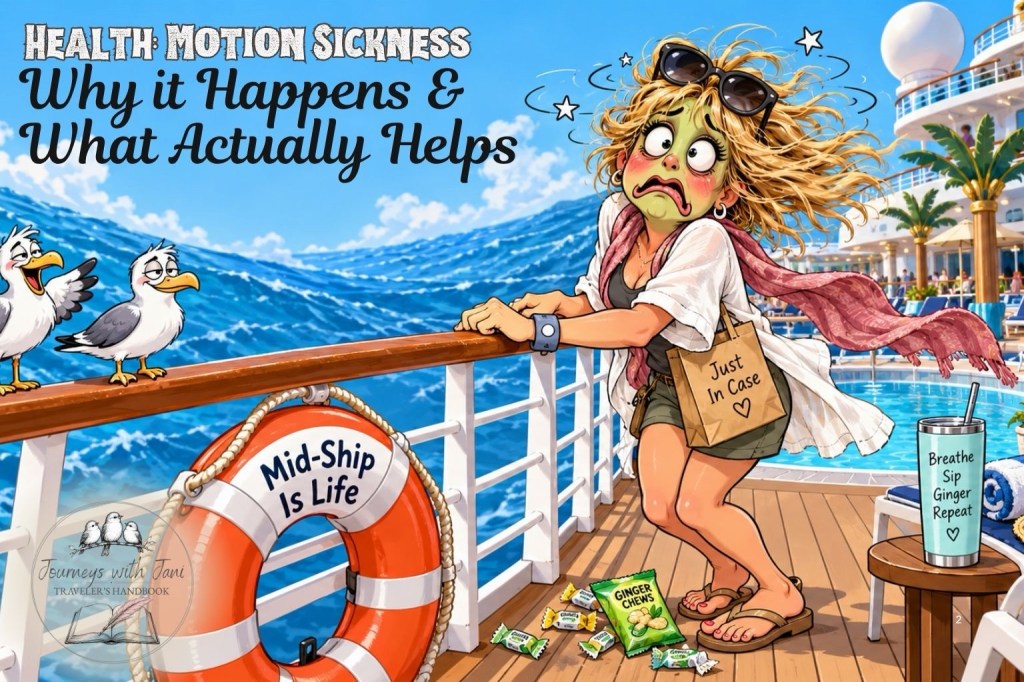
Why It Happens and What Actually Helps
In 10 Seconds
Motion sickness isn’t in your head, it’s a genuine mismatch between what your eyes see and what your inner ear feels, and it can hit you on a plane, a boat, or the back seat of a rental car. The good news is there are real fixes, not just “look at the horizon and hope.”
You’ll Learn
- Why motion sickness happens in the first place
- The best seat or cabin position for each mode of travel
- What actually works, from ginger to wristbands to medication
- Why cruise ships hit some people harder than they expect
- Simple habits that head off the problem before it starts
Why Your Body Does This to You
Motion sickness comes down to a disagreement between your senses. Your inner ear feels movement, your eyes are looking at something that appears still, like the inside of a car or the pages of a book, and your brain doesn’t know which signal to believe. That confusion is what triggers the nausea, the cold sweat, and the general “I need to lie down” feeling.
It affects people differently, and it’s not a character flaw or something you can just tough out through willpower. Some people are more prone to it than others, and it can show up in one form of travel and never bother you in another. Plenty of people who are fine on a plane get seasick on a boat, or fine on a boat and miserable in the back seat of a car.
The Seat You Choose Actually Matters
Where you sit changes how much conflicting information your brain has to process, so this is genuinely one of the most effective free fixes available.
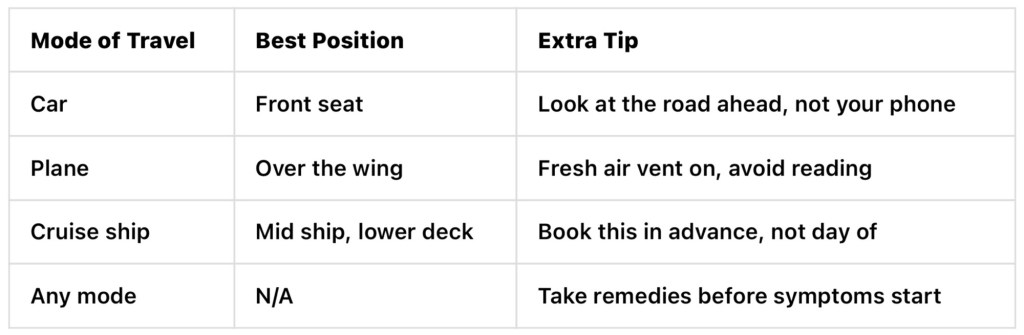
🚘 In a car: The front seat is better than the back, and looking out at the road ahead helps more than looking down at a phone.
✈️ On a plane: A seat over the wing tends to feel the most stable, since it’s closer to the plane’s center of gravity, where you feel less of the up and down motion during turbulence.
🚢 On a boat or cruise ship: Lower decks and cabins toward the middle of the ship move the least. A cabin at the front or back of a high deck will feel every bit of the ship’s motion, while a mid ship, lower deck room barely moves at all.
💡 Jani’s Tip: We steer clients toward mid-ship cabins on cruises. People who’ve never had a motion sickness problem in their life can still feel it on a ship if they’re in the wrong spot, and it’s such an easy thing to avoid with the right cabin placement before you ever set sail.
What Actually Helps
There’s a real range of options here, and what works best depends on how sensitive you are and how much advance planning you’re willing to do.
- Ginger in candy, tea, or capsule form is a legitimate first line option for mild cases, and it’s gentle enough to try before reaching for anything stronger.
- Acupressure wristbands apply light pressure to a point on the inner wrist and work well for people with mild to moderate symptoms, with zero drowsiness involved.
- Over the counter medication like Dramamine or the less drowsy Bonine can be effective, and are worth taking before symptoms start rather than after, since they work better as prevention than as a cure once you’re already feeling it.
- Prescription options, like a scopolamine patch, are available for people with more severe or persistent motion sickness, and are worth a conversation with your doctor if the over the counter route hasn’t been enough.
- Fresh air and a fixed point on the horizon genuinely help in the moment, which is part of why cracking a car window or stepping out on a ship’s deck can bring real relief.
💊 Jani’s Tip: Whatever you choose, take it before you need it, not after. Motion sickness remedies work best as prevention. Once you’re already feeling it, you’re playing catch up, and it takes a lot longer to feel better than it would have taken to just stay ahead of it.
Habits That Head It Off
- Avoid reading or looking at your phone during a bumpy stretch of travel, it makes the sensory mismatch worse.
- Eat something light before traveling rather than nothing at all, or something heavy and greasy right beforehand.
- Stay hydrated, dehydration makes nausea worse across the board.
- If you know you’re prone to it, request your seat or cabin location in advance rather than hoping for the best at check in.
Quick Reference
One Last Thing…
Motion sickness can turn a good trip into a miserable one fast, but it’s also one of the most preventable travel problems out there once you know what actually works. A little planning, the right seat, and being ahead of it instead of behind it makes a bigger difference than most people expect.
If you tend to get motion sick and you’re not sure how to plan a cruise cabin or a flight seat around it, that’s exactly the kind of detail I sort out before you ever book. taketimetotravelga.com
XOXO, Jani ~ Personal Travel Advisor | Take Time To Travel, LLC
One page at a time, we’re building a smarter way to travel.
Updated September 2026. This is general travel wellness information, not medical advice. Talk to your doctor before starting any new medication, including over the counter options, especially if you’re pregnant, nursing, or taking other medications.
Related Traveler’s Handbook Articles
Health
On the Plane
 Journeys With Jani: Traveler’s Handbook
Leave a comment