Portable Chargers Which One Do You Actually Need?
In 10 Seconds
A portable charger only earns its spot in your bag if it fits your trip, not your Amazon cart. Here’s how to pick the right size, skip the gimmicks, and stop packing three chargers when one good one would’ve done the job.
You’ll Learn
- How much battery capacity you actually need, in plain numbers
- Why more mAh isn’t automatically better
- Wired versus wireless charging, and which one holds up on the road
- What solar chargers are actually good for (hint: not what the packaging implies)
- The one charging habit that keeps your cords from turning into a rat’s nest
Everybody Owns One. Nobody Picked It On Purpose.
I’d bet money that if I looked in your junk drawer right now, I’d find at least two portable chargers. One was a gift. One came free with something else. Neither one is the right size for how you actually travel, and both are probably dead, because nobody remembers to charge the charger.
That’s the real problem with portable chargers. People buy them the way they buy phone cases, whatever’s cheap and nearby, and then wonder why it dies somewhere over Nebraska. Let’s fix that.
How Much Battery Do You Actually Need
This is where most people either way overbuy or way underbuy, and there’s no in between.
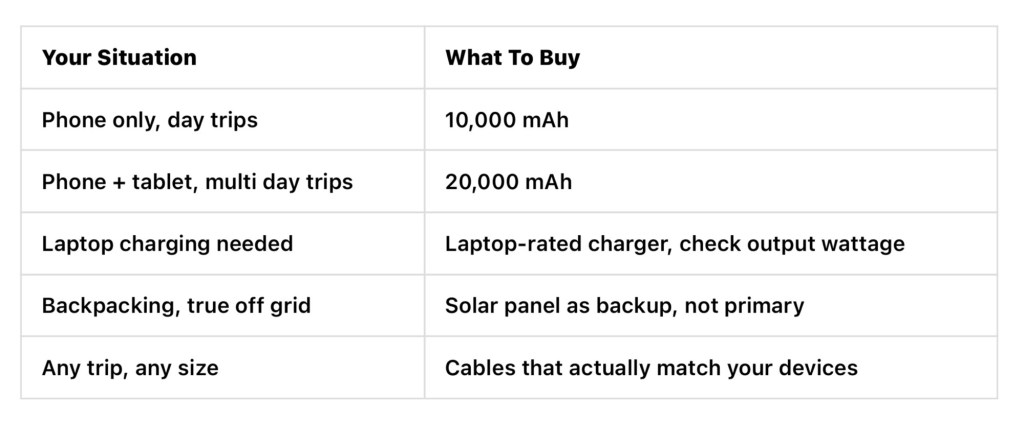
A modern smartphone battery holds somewhere around 3,000 to 4,500 milliamp hours, depending on the phone. A portable charger rated at 10,000 mAh will get you roughly two full phone charges, sometimes a little less once you account for the energy lost in the transfer. It’s not a perfect one to one trade, and any charger that claims it is exaggerating.
If you’re a phone only traveler, a 10,000 mAh charger covers a long airport day or a day of sightseeing with the GPS running the whole time.
If you’re charging a phone and a tablet, or you’re gone from an outlet for two days straight, step up to 20,000 mAh.
If you’re trying to charge a laptop, you need a charger specifically rated for that, with enough wattage output to actually push power into a laptop battery, not just a phone. Check the output wattage, not just the mAh, or you’ll plug in and watch nothing happen.
☕ Jani’s Tip: I carry a 10,000 mAh charger in my everyday bag and a 20,000 mAh one in checked luggage for actual trips. That’s the whole system. I don’t own five chargers of five different sizes. I own two, and I know exactly what each one is for.
Wired vs. Wireless, and Why I’m Still Team Cable
Wireless charging pads feel modern and futuristic and like something out of a spaceship. They’re also slower, less efficient, and completely useless the second your phone shifts half an inch off the coil, which happens constantly in a moving car, a bumpy shuttle, or basically anywhere you’re actually traveling.
A wired connection charges faster and doesn’t care if your hand moves. For travel specifically, wired wins. Save the wireless pad for your nightstand at home, where nothing’s bouncing around and you’re not in a hurry.
Solar Chargers: Handle With Realistic Expectations
Solar phone chargers get marketed like they’ll keep you powered up forever, off grid, no outlet required. In reality, most consumer solar panels charge slowly, need direct unobstructed sunlight for hours, and produce a fraction of what a wall outlet or a regular battery pack delivers.
They’re genuinely useful for backpacking, long hikes, or multi-day outdoor trips where there’s truly no outlet in sight. They are not a substitute for a real battery pack on a normal vacation. Don’t let a cute solar panel talk you out of packing a charger that’ll actually work when you need it.
The Cable Situation Nobody Wants to Talk About
Here’s the thing about portable chargers: the charger is only half the equation. The cable matters just as much, and this is where most people’s setups fall apart.
USB-C has become the standard across most new phones, tablets, and laptops, but plenty of people are still carrying an old Lightning cable, an old micro USB cable, and a USB-C cable, and none of them match the ports on what they’re actually traveling with. Before your next trip, do a five minute check. Lay out every device you’re bringing, check its port, and make sure your cables actually match. It sounds obvious. It is somehow never obvious until you’re standing in a hotel room at 11pm with the wrong cable and a dying phone.
🔌 Jani’s Tip: I keep one small zippered pouch that holds nothing but cables and my charger, and it travels with me every single trip. No digging through a suitcase side pocket wondering which cord goes with what. Everything lives in one place, every time.
A Word on TSA and Battery Rules
Portable chargers are lithium ion batteries, which means they’re carry on only, no exceptions, on every major airline. The full breakdown on watt hour limits, how many you can bring, and how airlines have been tightening these rules is covered start to finish in Travel Electronics & Chargers Made Simple. If you haven’t read that one yet, that’s your homework before you pack.
Quick Reference
One Last Thing…
A portable charger is one of those things you don’t think about until the exact moment you desperately need one, and by then it’s too late to shop around. Pick the right size for how you actually travel, keep the cables that match it, and you’ll never again be the person crouched next to an airport outlet with three other strangers, all of you silently competing for the same plug.
If figuring out what you actually need for a trip, chargers included, sounds like more decision fatigue than you signed up for, that’s exactly the kind of thing I sort out before you’ve even finished packing. taketimetotravelga.com
XOXO, Jani ~ Personal Travel Advisor | Take Time To Travel, LLC
One page at a time, we’re building a smarter way to travel.
Updated September 2026. Battery capacities, charging standards, and airline carry on rules can change, always verify current specs and airline policy before you fly.
Related Traveler’s Handbook Articles
Technology
Before You Go
 Journeys With Jani: Traveler’s Handbook
Leave a comment