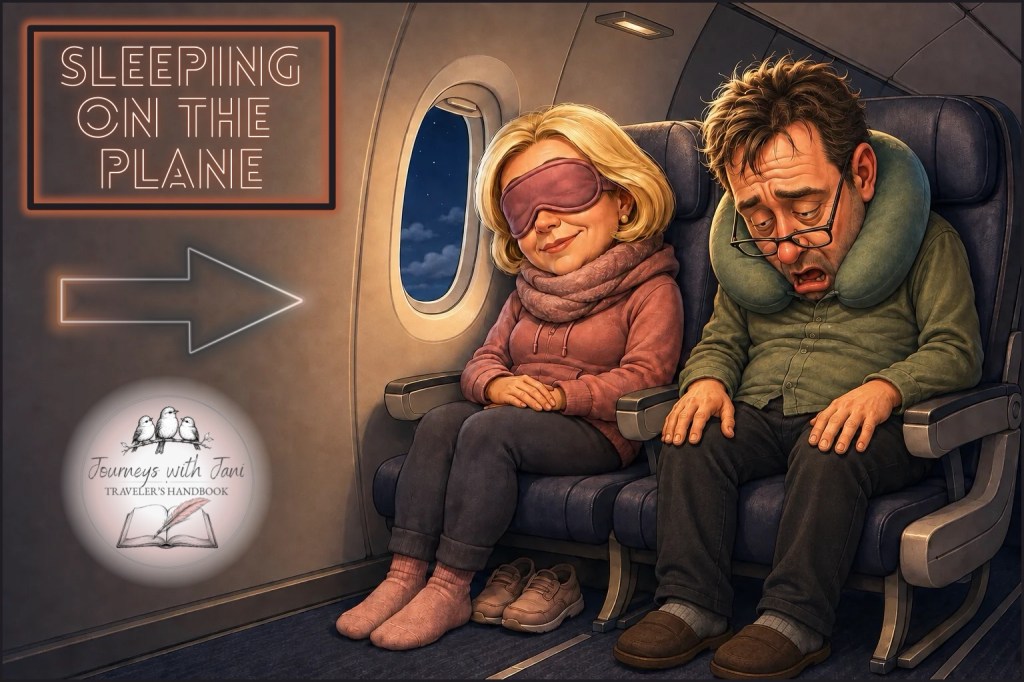
Sleeping on a Plane
In 10 Seconds
Nobody sleeps well sitting upright in a chair that reclines four inches while a stranger’s elbow negotiates for territory. But most people make it harder than it has to be, usually by buying the wrong pillow and drinking the wrong thing. Real airplane sleep comes down to three things: where you sit, what you do with your head, and how honest you are about what your body will actually accept. Here is how to stack the odds.
You’ll Learn
- Why sleeping upright is physically harder than it looks, and what that means for your setup
- The seat choices that make or break your rest before you ever board
- Why the classic U-shaped neck pillow works against most people
- What to drink, what to skip, and the sleep aid rule I will not budge on
- How to build a flight day sleep kit that fits in a personal item
First, Why This Is So Hard
Falling asleep requires your body to do a few things it cannot easily do in seat 24B.
Your core temperature needs to drop slightly. Your muscles need to release. Your head needs to stop actively working to stay balanced on top of your neck. That last one is the real culprit. When you doze off sitting upright, your neck muscles let go and your head pitches forward, which pulls you right back awake. Then you do it again. And again. That is not sleep. That is forty rounds of a very boring game.
Add cabin noise running steady in the seventy to eighty five decibel range, air so dry your throat feels like a gravel driveway, a cabin pressurized to roughly six to eight thousand feet of elevation, and a service cart that arrives precisely when your eyes finally close. It is a wonder anyone sleeps at all.
The good news is that almost every one of those problems has a fix, and none of the fixes are expensive.
Jani’s Tip Stop chasing deep sleep on a two hour flight. You are not going to get it, and trying is what makes you cranky. On short hops, aim for genuine rest with your eyes closed. On overnight flights, aim for sleep. Knowing which flight you are on changes everything about how you prepare.
Your Seat Decides More Than Your Pillow Does
I can hand you the best sleep kit money can buy and it will not save you from the last row by the lavatory.
Pick the window. Not negotiable if sleep is the goal. You get a wall to lean on, control of the shade, and nobody climbing over you at hour three to stretch their legs. Aisle sleepers get bumped by carts and shoulders all night long.
Get forward of the wing if you can. The engines sit under the wing, and the cabin is meaningfully quieter in front of them. Behind the wing, you are riding in the noisiest section of the airplane.
Avoid the galley and the lavatories. Lights on all night, doors opening and closing, and the unmistakable sound of a hundred and forty people using one bathroom. The last row often has limited recline too, and on some aircraft, none at all.
Know what you are giving up in an exit row. Extra legroom is lovely. Seats that do not recline and armrests that do not lift are not. If sleep is the priority, a standard seat that reclines usually beats an exit row that does not.
Bulkhead is a trade. Legroom without a seat in front of you also means no under seat storage during takeoff and landing, and no wall to lean forward against. Great for stretching out, mediocre for sleeping.
If you want the full breakdown of which seat serves which purpose, I wrote a whole piece on it, and it is linked at the bottom.
The Neck Pillow Nobody Talks Honestly About
The standard U-shaped travel pillow was designed to keep your head from falling sideways. Fine. The problem is that most heads do not fall sideways. Most heads fall forward.
So people buy the horseshoe, wear it the normal way, doze off, and their chin drops straight down into the open gap in the front. The pillow did exactly what it was built to do and it still failed them.
Three fixes, in order of how likely I am to recommend them:
Turn it around. Wear the U backward, with the opening at the back of your neck and the thick part under your chin. It looks ridiculous. It works. You are on an airplane, dignity left at the jet bridge.
Get a wrap or scarf style support that fastens under the chin and supports the jaw. These are built around the actual problem instead of the imagined one.
Use a real scarf. A large pashmina wrapped snugly around your neck does most of the job, doubles as a blanket, and does not dangle off your bag like a horseshoe of shame in the security line. I have used a scarf on more flights than I have used a pillow.
Whatever you choose, add a small lumbar pillow or a rolled sweatshirt at the base of your spine. Airplane seats curve outward exactly where your back curves inward. Fill that gap and your whole posture improves.
Jani’s Tip Test your pillow at home in a dining room chair before you take it on a nine hour flight. Sit up straight, close your eyes, and see what your head does. Ten minutes in your own kitchen will tell you more than any product review.
Blocking Out the World
An eye mask is the single highest return item in the bag. Darkness triggers melatonin release. A thin scrap of fabric over your eyes genuinely tells your brain it is nighttime, even at two in the afternoon over Kansas. Buy a contoured one with molded eye cups so it does not press on your lashes. Under twenty dollars, works every time.
Noise canceling headphones or foam earplugs, but understand the difference. Noise canceling is superb at killing the steady drone of engines and does very little about a crying baby or a loud conversation. Foam earplugs handle sudden sharp noises better but leave the drone. Some people wear both, and honestly, some people should.
Brown noise or a rain track beats music. Music has structure, and structure keeps part of your brain listening for what comes next. Steady noise gives it nothing to follow. Download it before you leave, because airplane wifi is a coin flip and streaming will eat your battery.
What to Drink, and the One Rule I Will Not Bend
Alcohol is the most popular sleep strategy in commercial aviation and one of the worst. It knocks you out fast, then fragments the second half of your sleep, dehydrates you in an already bone dry cabin, and hands you a headache on descent. At altitude it also hits harder than it does on the ground. One glass is a reasonable choice. Three is buying tomorrow morning’s misery on credit.
Caffeine has a half life of roughly five to six hours in most adults, which means that four o’clock airport latte is still doing business in your bloodstream at ten. If you are flying overnight, cut it off early in the afternoon.
Water is the boring answer and the right one. Bring an empty bottle through security and fill it past the checkpoint so you are not waiting on a cart.
And here is the rule. Never take a sleep aid for the first time on an airplane. Not a prescription one, not melatonin, not the over the counter antihistamine your neighbor swears by. You have no idea how your body responds, and thirty thousand feet with no exit is a terrible laboratory. If you want to use something, talk to your doctor or pharmacist, try it at home first on a night when nothing is at stake, and know how you react before you are strapped into a middle seat over the Atlantic.
There is one more reason to be careful. Sleep aids make you still, and stillness for hours at a time is the thing that raises circulation risk on long flights. If you are going to be genuinely out cold, take the window, set an alarm on your watch, and get up at least once. That is covered in more detail in the in flight health post.
Setting Up Your Seat Like You Mean It
A few small mechanical things that make a real difference:
- Buckle the seatbelt over your blanket, not under it. Then a turbulence check does not wake you up.
- Recline early, before the meal service ends, and do it slowly. Once the cabin settles, everyone stops paying attention.
- Shoes off, socks on. Cold feet keep you awake and the floor is not somewhere you want your bare skin. Compression socks do double duty here.
- Layer. Cabins run cold at cruise and warm on the ground. A hoodie or wrap lets you adjust without asking anyone for a blanket.
- Put your personal item flat under the seat in front of you and rest your feet on it. Lifting your feet a couple of inches takes pressure off the back of your thighs and makes a surprising difference over six hours.
- Turn your phone face down and screen off well before you want to sleep. Scrolling until the moment you close your eyes is the same mistake you make at home, just at a worse altitude.
If You Cannot Sleep, Rest Anyway
Some people do not sleep on planes. Full stop. If that is you, stop treating the flight as a failed sleep opportunity and start treating it as rest.
Eyes closed, mask on, noise blocked, body still, no screen. That state is called quiet wakefulness, and it is meaningfully more restorative than watching four episodes of something you will not remember. You will land tired either way, but you will land less depleted.
And when you get there, get outside into daylight as soon as you reasonably can. Light exposure resets your internal clock faster than anything you did on the airplane.
Quick Reference: The Flight Day Sleep Kit
Everything here fits in a personal item with room to spare. Item Why it earns the space Contoured eye mask Triggers melatonin, blocks cabin lights Foam earplugs Cheap, tiny, handles sharp noise Chin supporting pillow or large scarf Stops the head drop that wakes you Compression socks Circulation plus warm feet Hoodie or wrap Temperature control without asking Empty water bottle Fill past security, no waiting on carts Downloaded brown noise track Steady sound, no wifi required Lip balm and saline spray Dry cabin air, hour four
One Last Thing…
Here is the part that gets overlooked. The best sleep decision on a long trip usually happens weeks before the flight, at the point where somebody picks the itinerary. A red eye that saves ninety dollars but hands you a day of walking around like a zombie is not a bargain. Neither is a connection that puts you in an airport at three in the morning.
That is the kind of thing I sort out for people all the time. When you book with me, I am looking at the whole shape of the trip, not just the fare: which flight lands you functional, which seats are actually worth paying for on that specific aircraft, and where a slightly different routing buys you a real night of sleep instead of six hours of head bobbing. If you would rather arrive ready to enjoy the place you paid to visit, come see me at Take Time To Travel. I will help you plan a trip that starts well before you land.
One page at a time, we’re building a smarter way to travel.
XOXO, Jani ~ Personal Travel Advisor | Take Time To Travel, LLC
Updated August 2026
This article is general travel guidance and is not medical advice. Sleep aids, including over the counter and natural supplements, affect people differently and can interact with medications and health conditions. Talk with your doctor or pharmacist before using anything to help you sleep while traveling, and always try it at home first.
Related Traveler’s Handbook Articles
On the Plane
Airport Know-How
Before You Go


Leave a Reply