
Chasing The Northern Lights
In 10 Seconds: Seeing the Northern Lights is one of those bucket list moments that people get genuinely wrong more often than you’d think, chasing the wrong season, the wrong location, or the wrong expectations entirely. A little planning turns “we saw a green smudge for four seconds” into the kind of night you talk about for the rest of your life.
You’ll Learn:
- When the season actually is, and why summer trips guarantee disappointment
- Where to go, and why location matters more than people realize
- What actually affects your odds on any given night
- How to set expectations so the trip feels magical either way
The Season Matters More Than the Destination
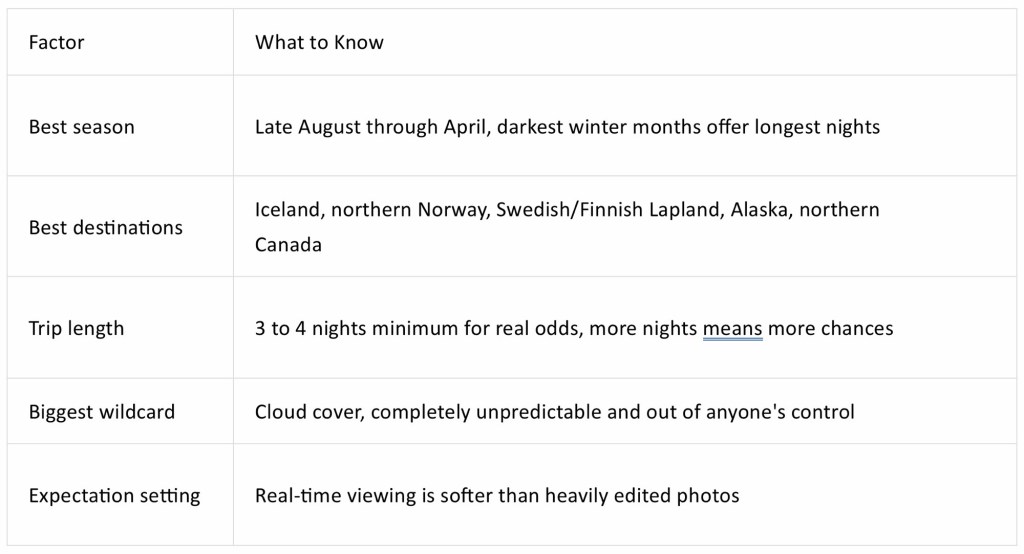
The Northern Lights are visible year round, technically, but you can only actually see them during dark enough skies, which rules out summer almost entirely in far northern destinations, since the sky barely gets dark at all during those months. The real viewing season runs roughly late August through April, with the deepest winter months typically offering the longest, darkest nights and the best overall odds.
This catches people off guard constantly. Someone books a beautiful Norway or Iceland trip in July because the weather sounds nicer, and quietly misses the one thing they actually came for. If seeing the lights is the priority, the trip has to be built around the season, not the other way around.
🎆 Jani’s Tip: Late February through March is a personal favorite window for a lot of Northern Lights travelers, since you often get slightly milder temperatures than peak winter while still holding onto genuinely dark, long nights.
Location Matters More Than People Realize
The aurora forms in a band around the earth’s magnetic poles, so certain destinations sit in a genuine sweet spot while others are simply too far south to see it reliably, no matter how good the night sky conditions are. Iceland, northern Norway, Swedish and Finnish Lapland, and parts of Alaska and northern Canada are the classic strong bets. Destinations further south might occasionally catch a faint glimpse during an exceptionally strong aurora event, but that’s a bonus, not something to plan a whole trip around.
Light pollution matters just as much as latitude. A city with any real light glow washes out all but the strongest aurora activity, so genuinely dark sky locations, away from town centers, dramatically improve your actual odds of seeing anything at all.
What Actually Affects Your Odds on Any Given Night
Cloud cover is the single biggest variable, and it’s completely out of anyone’s control. You can be in the perfect location during the perfect season with strong aurora activity happening, and if it’s cloudy that night, you see nothing. This is exactly why multi-night trips dramatically outperform single-night stops, more nights simply means more chances for clear skies to line up with active aurora conditions.
Solar activity itself runs in cycles, and some years offer stronger, more frequent aurora displays than others. Checking where we are in the current solar cycle before booking a trip built specifically around this can help set realistic expectations, though even a quieter cycle can still produce a beautiful night if the conditions line up.
🎆 Jani’s Tip: Build in at least three to four nights specifically for aurora viewing if this is the main reason for the trip. I’ve had clients see nothing the first two nights and then get an absolutely spectacular show on night three. Patience and multiple chances matter enormously here.
Setting Expectations So the Trip Feels Magical Either Way
Photos you’ve seen online are often long exposure shots that capture more vivid color than the human eye sees in real time. The lights in person are often a softer, more ghostly green or white, with the vivid colors becoming more visible the stronger the display is that particular night. Knowing this ahead of time means you’re not disappointed by a real, genuine sighting just because it doesn’t look exactly like a heavily edited photograph.
Building a trip that’s wonderful even without the lights, cozy lodges, hot springs, genuinely beautiful winter scenery, means the Northern Lights become a stunning bonus on top of a great trip rather than the single point on which the whole vacation’s success rests.
Quick Reference
One Last Thing…
Chasing the Northern Lights is one of the most rewarding trips I help plan, and also one where a little bit of real knowledge upfront makes an enormous difference in how the whole thing feels. I build in the right season, the right location, and enough nights to give you a real shot, plus a trip that’s wonderful with or without the sky cooperating.
Ready to plan a trip built around actually seeing them? Let’s talk it through.
XOXO, Jani ~ Personal Travel Advisor | Take Time To Travel, LLC
Updated September 2026.
Related Traveler’s Handbook Articles
Packing
Seasonal Travel
 Journeys With Jani: Traveler’s Handbook
Leave a comment