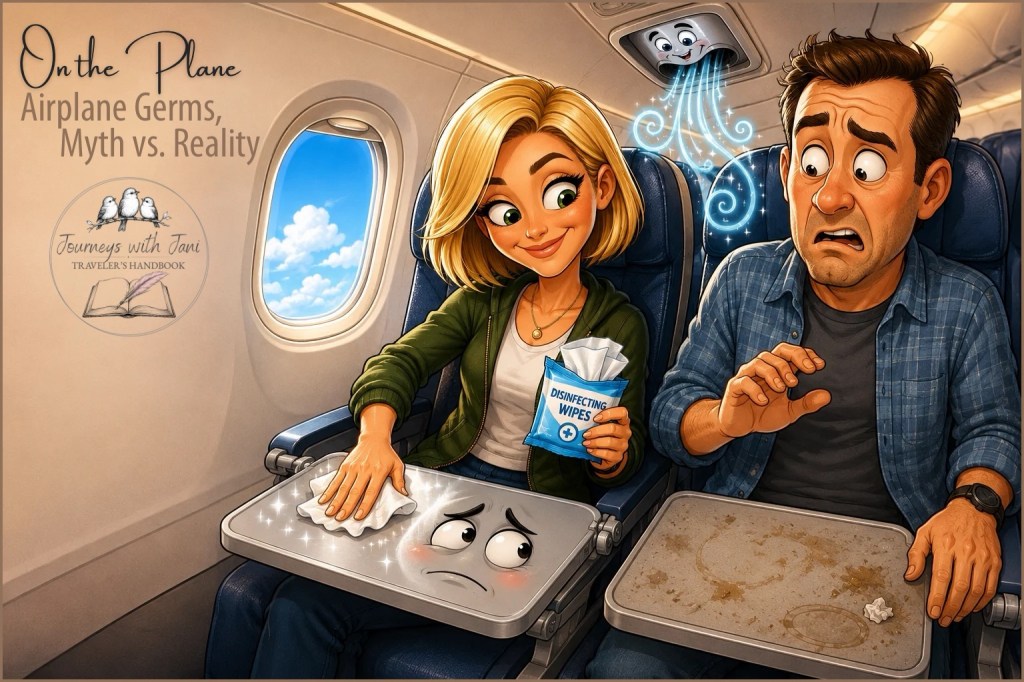
Airplane Germs, Myth vs. Reality
In 10 Seconds
The air on an airplane is cleaner than almost anyone believes. The surfaces are dirtier than almost anyone wants to know. Most of what makes you feel like a wrung out dishrag after a flight is not a virus at all, it is dry air, no sleep, and a bag of pretzels standing in for lunch. Here is what is actually true, what is airport gossip, and the handful of small habits that genuinely help.
You’ll Learn
- How cabin air really works and why it is not the villain
- The surfaces that deserve your side eye
- Whether that little overhead vent helps or hurts
- Why you feel awful after flying even when you do not get sick
- What to pack, what to skip, and what to do if you are the one who is sick
Let’s Talk About the Air, Because Everybody Gets This Wrong
Ask ten people what makes you sick on a plane and nine of them will say the recycled air. It is the most repeated piece of travel folklore out there, right up with “you have to break in new shoes on vacation.”
Here is the reality. Most commercial jets pull in fresh outside air and mix it with cabin air that has been run through HEPA filtration, the same grade of filter used in hospital settings. It catches the overwhelming majority of airborne particles, including the ones carrying bacteria and viruses. The full volume of cabin air gets swapped out and refiltered roughly twenty to thirty times an hour. Your living room does not come close. Neither does the airport gate you just spent ninety minutes sitting in.
The air also moves top to bottom rather than front to back, which means it is not touring the length of the cabin visiting everyone on its way to the galley.
One important caveat. That filtration system works hardest when the engines are running and the plane is moving. Sitting at the gate with the door closed and the auxiliary power struggling is the weakest link in the chain. If you have ever noticed the cabin feels stuffy during a long ground delay, you were not imagining it.
Jani’s Tip The riskiest air you breathe on travel day is usually not on the airplane. It is in the security line, the crowded gate area, and the shuttle bus with no windows. Nobody ever blames the shuttle bus.
Now the Part Nobody Wants to Hear
The air is fine. The surfaces are a different story.
Airplanes turn around fast. On a quick domestic turn, the cleaning crew may have fifteen minutes to handle an entire cabin, and that time goes to visible trash first. Deep cleaning happens, but it happens on a schedule that does not match every single flight.
The spots that consistently show up as the grubbiest:
The tray table. The undisputed champion. It is a flat surface at hand height that has held laptops, feet, diaper changes, and someone’s lunch. It also does not get wiped between most flights.
The seatback pocket. A soft fabric pouch that swallows tissues, banana peels, gum, and the safety card, then never gets emptied properly. Do not put your phone, your snacks, or your glasses in there. Truly.
The seatbelt buckle. Every passenger who has ever sat in that seat has touched it, and nobody has ever wiped it.
The lavatory door latch and flush button. Small space, high traffic, limited handwashing enthusiasm from the general public.
The seatback screen and remote. Fingerprints on fingerprints.
The aisle seat headrest. Everybody walking to the restroom grabs it for balance. Including the people coming back from the restroom.
Jani’s Tip Wipe the tray table, the buckle, the armrests, and the screen the second you sit down. It takes forty seconds and it is the single highest value thing you can do on the whole airplane. Bring the wipes. Do not count on the airline having them.
The Overhead Vent Debate
You will hear two absolute positions on this. Turn it off, it is blowing germs on you. Turn it on full blast, it creates a protective air curtain.
The honest answer sits in the middle. That vent is delivering filtered air, not raw cabin funk, so it is not spraying anything sinister at you. Aiming it slightly in front of your face so the air flows down past you rather than straight into your nose is a reasonable, low effort habit. Just do not expect it to work like a force field, and do not blast your own sinuses into the desert for four hours.
Why You Feel Terrible Even When You Did Not Catch Anything
This is the part that gets misdiagnosed constantly. You land, your throat is scratchy, your head hurts, your eyes feel like sandpaper, and you announce that you caught something on the plane. Usually you did not.
The humidity. Cabin humidity often sits in the range of ten to twenty percent. The Sahara Desert averages around twenty five. Your nose and throat rely on moisture to trap and clear the junk you breathe in. Dry them out for five hours and everything feels raw, and your natural defenses genuinely do work less well.
The dehydration. Dry air, one small cup of ginger ale, maybe a coffee, maybe a glass of wine. You did the math on that one already.
The sleep. Up at four in the morning, a middle seat, a crying baby two rows back, and a stranger’s elbow. Your immune system does its best work while you are asleep, and you did not give it any.
The pressure change. Sinus and ear pressure shifts feel remarkably similar to the start of a head cold.
The incubation window. If you get sick two days after landing, you were probably exposed before you ever boarded. Most common respiratory bugs need a day or more to show up. The airplane just makes a convenient suspect because it is where you were confined and miserable.
What Actually Helps
Practical, in order of how much they matter.
- Wipe your seat area. Tray table, buckle, armrests, screen, window shade. Forty seconds.
- Keep your hands away from your face. This is the whole ballgame. Surfaces do not infect you. Your own hands do, when they deliver something to your eyes, nose, or mouth.
- Wash or sanitize before you eat. Especially after the lavatory, and especially before you touch a pretzel bag.
- Drink water. More than you think. Bring an empty bottle through security and fill it past the checkpoint. Buying a bottle at the gate works too, and airplane cups hold about four sips.
- Saline nasal spray. Underrated, cheap, and it does more for the dry sinus misery than anything else in your bag. A little lip balm and eye drops belong in the same pouch.
- Skip the coffee and tea. Onboard hot drinks are made with water from the aircraft tank, and tank water quality varies more than anybody would like. Bottled, canned, and sealed drinks are a safer bet. So is coffee bought in the terminal.
- Bring your own blanket or a large scarf on long flights. Sealed blankets are genuinely sealed. Unsealed ones may have been folded, not laundered.
- Sleep the night before. The least glamorous advice on the list and the most effective.
Jani’s Tip I keep a small zip bag in my personal item with wipes, hand sanitizer, saline spray, lip balm, and a couple of tissues. It lives there permanently. I do not repack it each trip, I just restock it. Fifteen years of this and it has never once been the thing I regretted carrying.
What About Masks?
Purely your call, and it is no longer a policy question on most airlines, it is a personal one. A well fitting mask does reduce what you breathe in and what you send out, and it has a bonus side effect that nobody talks about, it holds moisture near your face, so your nose and throat do not dry out as badly. Some travelers wear one only for boarding and deplaning, which happens to be when the cabin is fullest and the air system is working the least. That is a very sensible compromise.
If You Are the Sick One
Say the trip is paid for and you wake up on departure day with a chest full of gravel. Straight talk.
Flying with a genuine fever is a bad idea for everyone including you, and airlines can deny boarding to a visibly ill passenger. If you are running a fever, call me or call the airline before you head to the airport rather than after.
If it is a mild cold, fly if you must, but be kind about it. Mask up, keep your tissues in your own trash bag and not the seatback pocket, and use a decongestant before takeoff so your ears do not turn the descent into an ordeal. Congested ears plus a pressure change is one of the more genuinely painful things that can happen to you at thirty thousand feet.
And this is exactly why travel insurance exists. A trip you cannot take is a much smaller problem when somebody else is covering the cost of it.
Quick Reference: Myth vs. Reality
The Myth The Reality The recycled air makes you sick Cabin air is HEPA filtered and swapped out twenty to thirty times an hour Air blows front to back through the cabin It generally flows top to bottom in sections, not down the aisle The overhead vent sprays germs on you It delivers filtered air. Aim it in front of your face if you like Window seats are the safest Seat location matters far less than hand hygiene and what you touch The plane is the germiest part of travel day The gate, the security line, and the shuttle usually beat it The tray table is fine, it looks clean It is the dirtiest surface you will touch all flight I caught this on the plane If symptoms hit within hours, you were exposed before you boarded Airline coffee is harmless It is made with tank water. Buy it in the terminal instead Hand sanitizer alone is enough Soap and water wins, and not touching your face wins bigger Getting sick after flying is inevitable Most post flight misery is dry air, dehydration, and no sleep
One Last Thing…
Flying is not the biohazard the internet has made it out to be. It is a dry, crowded, sleep deprived environment with a handful of sticky surfaces, and once you know which forty seconds of effort actually matter, you can stop worrying about the rest and enjoy the fact that you are going somewhere.
That is the whole point of the Handbook, really. Less second guessing, more looking forward to the trip.
And when you are ready to plan the trip itself, that is my favorite part. I handle the details, the timing, the “wait, do we need travel insurance for this” questions, and the thousand small decisions that turn a good trip into a smooth one. Come see me at taketimetotravelga.com and let’s get something on the calendar.
XOXO, Jani ~ Personal Travel Advisor | Take Time To Travel, LLC
Updated August 2026
General wellness and travel comfort information only. Not medical advice. If you have a health condition, are pregnant, or are unsure about flying while ill, talk with your doctor before you travel.
Related Traveler’s Handbook Articles
On the Plane
Airport Know-How
Before You Go


Leave a Reply