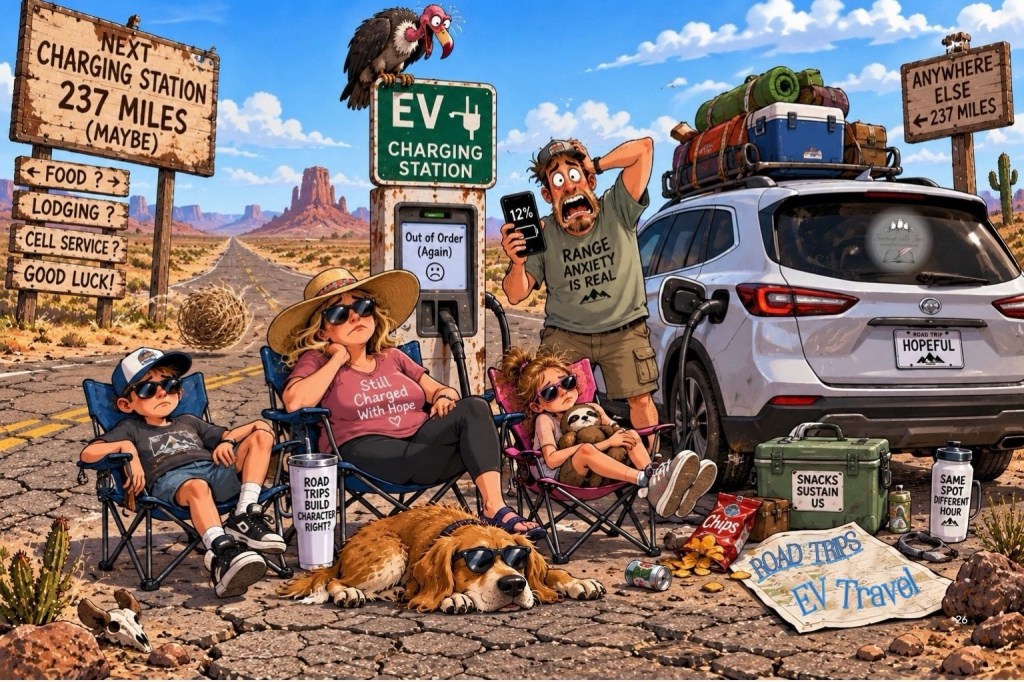
EV Travel – Even My Car Needs a Charge!
In 10 Seconds: Road tripping in an electric vehicle isn’t harder than a gas powered trip, it’s just planned differently, and treating it exactly like a gas trip is the fastest way to end up stressed out in a parking lot watching a charge percentage climb one painful point at a time. A little route planning turns an EV road trip into a genuinely smooth, often cheaper version of the trip you’d have taken anyway.
You’ll Learn:
- Why EV road trips require planning ahead of time, not along the way
- What actually affects real world range
- How to think about charging stops differently than gas stops
- What to check before you commit to a route
Plan the Route Before You Leave, Not Along the Way
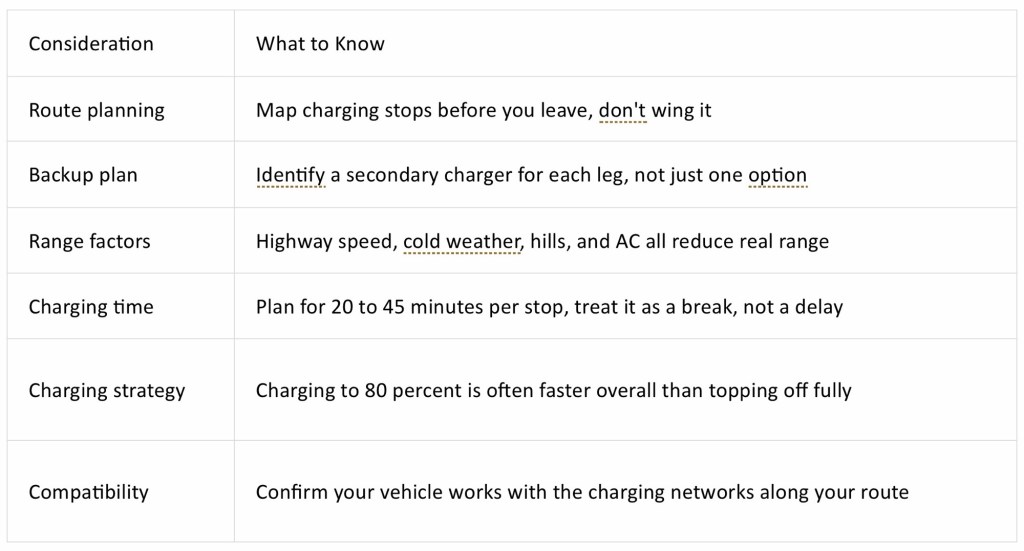
Gas station culture has trained everyone to assume fuel is basically everywhere and refueling is a five minute afterthought. EV charging, especially fast charging suitable for road trips, is nowhere near that ubiquitous yet, and stations cluster in some regions while leaving real gaps in others, particularly in rural stretches of the country. Mapping your entire route’s charging stops before you leave, not figuring it out as you go, is the single biggest difference between a smooth EV road trip and a stressful one.
Several route planning apps exist specifically for this, factoring in your vehicle’s real range, elevation changes, and charger availability along a specific route, and they’re worth using even if you’re generally more of a “wing it” road tripper by nature. This particular trip rewards the planning.
🔌 Jani’s Tip: Always have a backup charging stop identified for each leg of the route, not just your primary choice. Chargers do go down or get occupied, and having a plan B already researched beats frantically searching while your charge percentage keeps dropping.
What Actually Affects Real World Range
The range number on a car’s window sticker is measured under fairly ideal conditions, and real world driving rarely matches it exactly. Highway speeds, especially sustained speeds over 70, reduce range more than city driving does, opposite of how a lot of people intuitively think about it. Cold weather affects EV range significantly, sometimes reducing it by a notable percentage, since the battery itself works harder in low temperatures and cabin heating draws additional power. Hills, headwinds, and running the air conditioning hard all chip away at range too, the same way they’d affect a gas car’s mileage, just more noticeably.
Building in a real buffer, planning to charge before you’re down to a sliver rather than pushing to the absolute limit, accounts for these variables without turning every drive into a nail biter.
How to Think About Charging Stops Differently Than Gas Stops
A gas stop is typically five to ten minutes. A fast charging stop is typically twenty to forty five minutes depending on the charger and how depleted the battery is, which changes the whole rhythm of a road trip day. This isn’t necessarily a downside, it just requires a different mindset, treating a charging stop as a built in meal break, a chance to actually get out and stretch, or time to explore a small town instead of a quick blip you’re trying to minimize.
Charging speed also isn’t linear, a battery charges quickly from a low percentage up to around 80 percent, then slows down noticeably after that. For road trip efficiency, it’s often faster overall to charge to about 80 percent and keep moving rather than waiting the extra time to top off completely at each stop.
🔌 Jani’s Tip: Build your charging stops around places you’d actually want to spend thirty minutes anyway, a good coffee shop, a walkable downtown, a scenic overlook. It turns a logistical necessity into one of the better parts of the trip.
What to Check Before You Commit to a Route
Confirm which charging networks are compatible with your specific vehicle, since not every charger works with every EV, and adapter availability varies. Check real reviews or recent status reports for chargers along remote stretches specifically, since a charger listed on a map isn’t a guarantee it’s actually working that day, particularly in less trafficked areas. If you’re renting an EV for a trip rather than driving your own, confirm the specific model’s real world range and charging network compatibility before you’re already on the road figuring it out.
Quick Reference
One Last Thing…
EV road trips have come a long way, and with a little planning upfront they can be just as smooth as a gas powered trip, sometimes smoother, since you’re forced into regular breaks that a lot of road trippers skip anyway when they’re trying to power through on gas alone. I help clients figure out whether an EV rental makes sense for a specific route and trip style before they’re stuck improvising halfway through Nowhere, USA.
Ready to plan a road trip that works with whatever you’re driving? Let’s talk it through.
XOXO, Jani ~ Personal Travel Advisor | Take Time To Travel, LLC
Updated September 2026. Charging networks, compatibility, and availability change frequently, always confirm current information for your specific vehicle and route before you travel.
Related Traveler’s Handbook Articles
Road Trips
 Journeys With Jani: Traveler’s Handbook
Leave a comment