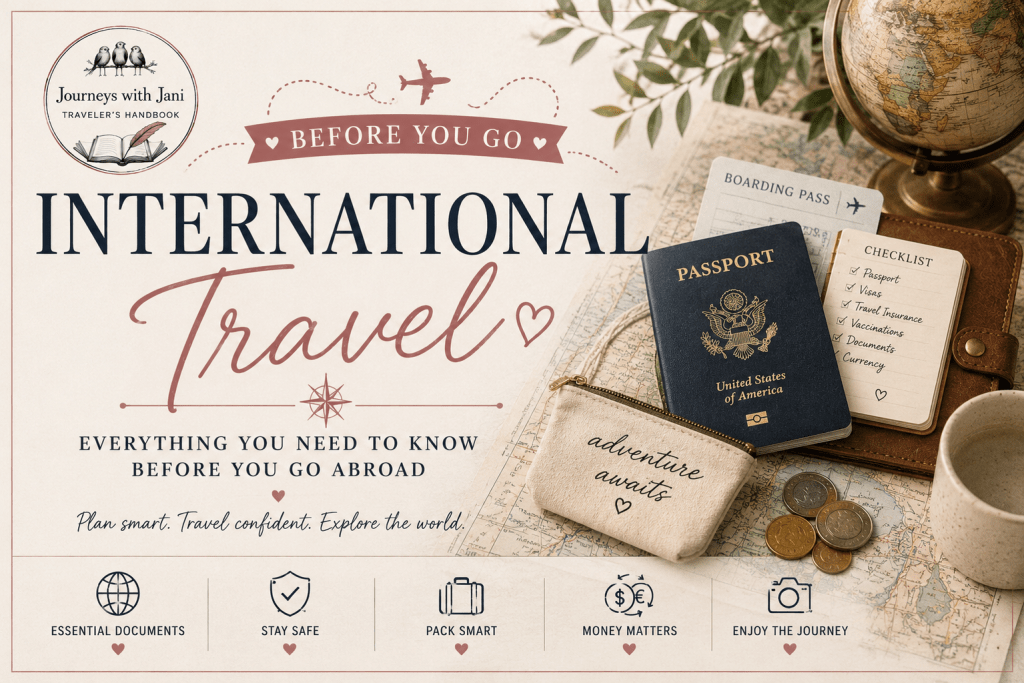
Before You Go: International Travel
In 10 Seconds
International travel isn’t domestic travel with a longer flight. It comes with its own homework: health prep, staying connected without bankrupting yourself, telling somebody official where you’ll be, and not accidentally insulting a country you were only visiting for four days. This is the roundup of everything else you need before you cross an ocean, plus the links to the deep dives we’ve already covered so you’re not hunting for them.
Domestic travel, you can wing a little. Forget your phone charger in Nashville and Target will happily sell you another one. Forget it in Lisbon and you’re standing in a foreign outlet store trying to mime “adapter” to a very patient stranger.
International travel rewards the people who planned ahead, and it has a real sense of humor about the people who didn’t. So let’s get you in the first group.
Your Body Needs a Passport Too
Everybody remembers to check their passport’s expiration date. Fewer people remember that their own body needs a little prep work before it crosses a border.
Start at the CDC’s Traveler’s Health site, which lists destination-specific vaccine recommendations and requirements. Some countries flat out won’t let you in without proof of certain vaccinations (yellow fever is the classic example for parts of Africa and South America). Others just strongly suggest you not find out the hard way what the local water does to a stomach that grew up on Chick-fil-A.
Jani’s Tip ☕: If you take prescription medication, keep it in the original labeled bottles, pack it in your carry on (never checked luggage), and bring a copy of the prescription or a doctor’s note, especially for anything controlled. Some countries have stricter drug laws than you’d expect, and “it’s my ADHD medicine” doesn’t mean much to customs in a country where that medication is banned outright. A little paperwork now saves you a very bad conversation later.
Staying Connected Without a Four Figure Phone Bill
Nothing ruins the glow of a European sunset faster than coming home to a phone bill that looks like a car payment.
An eSIM (we mentioned Airalo in our Travel Apps guide) is usually your cheapest, easiest option these days. You buy a data plan for your destination before you land, and you skip both the roaming fees and the airport kiosk selling overpriced local SIM cards to jet-lagged tourists who’ll pay anything at that point.
Whatever you choose, download offline maps, translation packs, and anything else you might need before you leave good WiFi behind. And if you’re doing any online banking or logging into work accounts on public WiFi, a VPN isn’t overkill, it’s just common sense.
The Adapter Isn’t Optional, and Neither Is the Voltage
A plug adapter lets your cord physically fit into the wall. A voltage converter handles the fact that other countries run their electricity at different strengths than we do.
Most phone chargers and laptop chargers handle both voltages automatically (check the fine print on the brick, it’ll say something like “Input: 100-240V”). Hair dryers and flat irons are usually the culprits that fry themselves in a European outlet, so check before you pack, or just plan to buy a cheap one at your destination.
Jani’s Tip ☕: Buy one universal adapter with multiple ports, not a bag of single-plug adapters. You will lose the single ones. Every single time.
Tell Somebody Official Where You’re Going
The State Department’s Smart Traveler Enrollment Program (STEP) is free, takes about five minutes, and lets the nearest U.S. embassy know you’re in the country. If something goes sideways, a natural disaster, a political situation, a family emergency back home, they can actually find you and help.
It also means you’ll get safety alerts specific to where you’re standing, which is a lot more useful than a generic push notification.
Culture, Customs, and Not Being “That American”
You don’t have to memorize an etiquette manual, but a few minutes of research goes a long way toward not standing out for the wrong reasons.
- Tipping varies wildly. What’s expected (and generous) in the U.S. can be confusing or even insulting elsewhere. Look it up for your specific destination.
- Dress codes matter more than you’d think, especially at religious sites. A scarf in your bag can save a whole visit.
- Learn five words. Hello, please, thank you, excuse me, and the check please. Locals notice the effort, even a clumsy one, and it changes how you’re treated.
- Public behavior norms differ. Volume, physical space, eye contact, all of it varies by culture. What’s friendly at home can read as rude somewhere else, and vice versa.
None of this requires you to become a different person. It just requires you to remember you’re a guest.
Time Zones Will Win the First Day, Let Them
You are not going to out-muscle an eight hour time difference through sheer willpower. Get sunlight as soon as you land, stay awake until a reasonable local bedtime even if it hurts, and don’t schedule anything critical for day one if you can help it.
Jet lag is temporary. A miserable first day of your trip because you tried to fight biology is just wasted vacation.
The Rest of It, We’ve Already Got You Covered
International trips pull together nearly everything else in this Handbook, so rather than repeat ourselves, here’s where to go for the pieces we’ve already built out properly:
- Documents and ID: Passports Made Simple, Real ID Explained, and Travel Documents You Should Always Carry
- Getting through the airport: TSA PreCheck, Global Entry, CLEAR & Digital ID and Conquering TSA
- Packing: How to Choose the Right Suitcase, Carry On vs. Checked Bag, and Packing Like a Pro
- Money: Money Matters: Cash, Credit Cards & Foreign Currency and Choosing the Right Travel Credit Card
- Insurance: Travel Insurance Explained
- A printable version of all of this: The International Travel Checklist in The Toolkit
Read this one for the why. Use those for the how.
One Last Thing… ☕
Here’s what twenty years in this business has taught me: the travelers who have the smoothest international trips aren’t the ones who got lucky. They’re the ones who did the boring prep work two months out instead of two days out.
You don’t have to do all of this alone, either. Between visa requirements that change by country, health guidance that shifts by season, and entry rules that seem to update the week before you leave, this is exactly the kind of thing I sort out for my clients every day so they can just show up and enjoy the trip.
One page at a time, we’re building a smarter way to travel.
XOXO, Jani ~ Personal Travel Advisor | Take Time To Travel, LLC
Updated August 2026
Entry requirements, health guidance, and travel advisories vary by country and change often. Always verify current requirements with the official government sources for your destination before you travel.
Related Traveler’s Handbook Articles
Before You Go
- Passports Made Simple
- Real ID Explained
- Travel Documents You Should Always Carry
- Travel Insurance Explained
- Money Matters: Cash, Credit Cards & Foreign Currency
- Choosing the Right Travel Credit Card
- Travel Apps Worth Downloading Before You Leave
Conquering the Airport
Packing


Leave a Reply