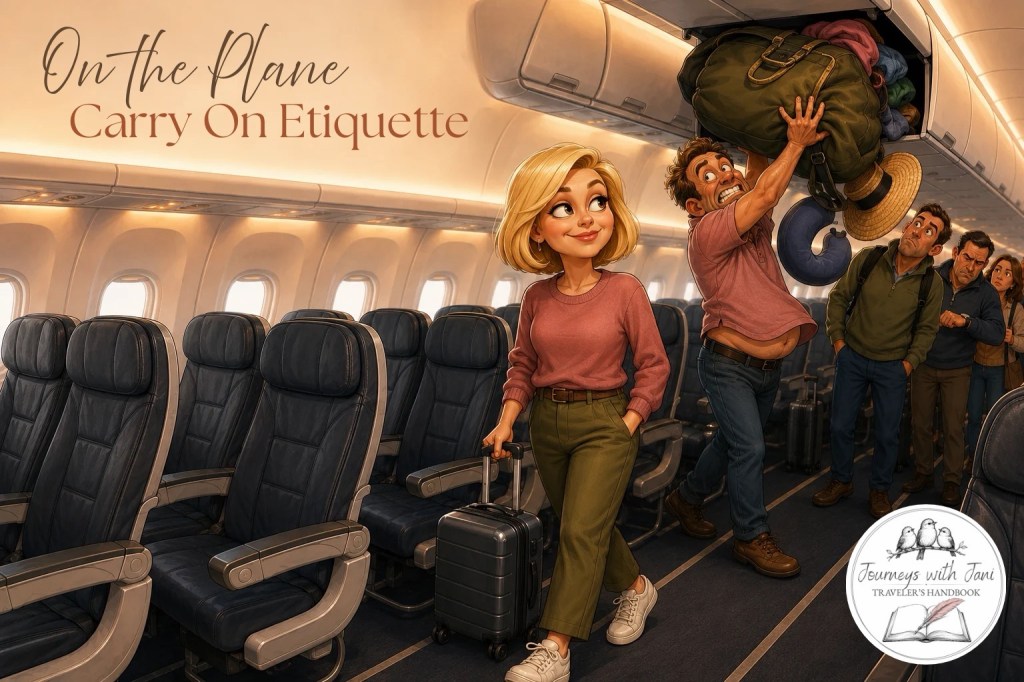
Carry On Etiquette
In 10 Seconds
The overhead bin is not assigned to you, it is shared with roughly a hundred and fifty strangers, and it holds about a third more bags when everyone loads it correctly. Big bag up, small bag under the seat in front of you, wheels in first, and never in a bin you’re going to walk past on your way to row 32. Do those four things and you have already been a better seatmate than half the airplane. The rest is knowing your fare, knowing your aircraft, and not standing in the aisle repacking your toiletries while forty people watch.
You’ll learn:
- The one bin mistake that costs the plane the most space
- Which bin is actually yours, socially speaking
- Why a perfectly legal bag still gets taken away at the gate
- What to do when they ask for gate-check volunteers
- How to deplane without becoming the story someone tells at dinner
Nobody Is Born Knowing This
Let me start by being fair about it. Almost nobody who commits these sins is a bad person. They’re a person who flies twice a year, has never been told any of this, and is doing their genuine best in a narrow metal tube while a hundred and fifty people watch.
So this isn’t a scolding. This is the stuff nobody tells you, written down, so you can be the person who makes boarding smoother instead of the person the flight attendant sighs at.
And I’ll be honest about my own record. I once loaded a bag wheels-out in a full bin on a Sunday afternoon out of Atlanta and took up enough space for two. A very patient flight attendant turned it for me without a word. I was a teenager. Give me grace. I’ve thought about that flight attendant ever since.
Sin Number One: The Personal Item in the Overhead Bin
This is the big one. If everybody fixed only this, boarding would get faster tomorrow.
You get two bags. The carry-on goes overhead. The personal item, your purse, your backpack, your laptop bag, goes under the seat in front of you. That’s not a suggestion. That’s the entire design of the system.
When somebody tosses a backpack into the bin because they’d rather have legroom, they have taken space that belonged to a full-size roller. Multiply that by fifteen people and the plane runs out of bin room around row 24, and now perfectly innocent travelers in the back are handing their bags over at the jet bridge because somebody up front wanted to stretch.
There is a real exception worth naming: if you have a medical device, a mobility need, or a genuine reason you cannot have a bag at your feet, that’s your business and nobody’s owed an explanation. That is different from preferring the extra room.
Jani’s Tip
Your power bank actually belongs under the seat, not overhead. Airlines increasingly want lithium batteries where you and the crew can see them, and that’s a safety rule rather than a courtesy. So build your personal item as your “everything I need in the air” bag: battery, medications, headphones, snacks, a change of shirt. Then your overhead bag can go up and stay up, and you’re not that person standing on the seat mid-flight, digging through it while the cart waits.
Sin Number Two: Wheels Out
A roller bag laid flat, wheels facing out into the aisle, eats up close to double the space it needs.
Wheels go in first, bag on its side, spine facing you. That’s how the bin was engineered. It’s how the airline’s own diagram shows it. It’s how you fit four bags in a space that was about to hold three.
If you board and see a bin loaded wrong, you’re allowed to turn a bag. Truly. Every frequent flyer on that airplane does it, and nobody has ever once objected.
Sin Number Three: The Bin You’re Never Coming Back To
Here’s the etiquette nobody publishes and everybody feels.
No airline assigns you a bin. Legally, the space above your head belongs to whoever gets there first. But the unwritten rule is this: your bag goes in a bin at your row or behind it. Never ten rows ahead of where you’re sitting.
Why it matters is a mechanical thing, not a moral one. If you’re in 30C and your bag is in bin 12, you have to fight upstream against the entire deplaning aisle to retrieve it. That is thirty extra seconds of a hundred people standing still, and it happens six times per flight.
The other version is the person in row 6 with the tight connection who now has no bin because a passenger from the back filled it on the way through. Both of you were reasonable. Only one of you is going to miss the flight to Dallas.
The Boarding Group Situation
Board when they call your group. Not before.
The crowd that gathers at the podium during Group 1 has a name among airline employees, and it isn’t flattering. It doesn’t get anybody on faster. It blocks the actual boarding lane, it makes gate agents repeat themselves, and it turns a routine process into a scrum.
If your fare boards in the last group and you’re worried about bin space, the honest answer is that hovering won’t fix it. What fixes it is packing a bag you can gate-check without losing anything you need. More on that in a second.
And once you’re aboard: step into your row before you deal with your bag. Or into an empty row, or up against the seat backs. Do not stand in the aisle unpacking your neck pillow, your book, and your snacks while the line stretches back to the jet bridge. Sit down, get settled, and pull what you need out once people can get past you.
Sin Number Four: Hoisting a Bag You Cannot Hoist
If you can’t lift your bag into the bin by yourself, that bag is too heavy for you. That’s not a character flaw, that’s arithmetic.
Two things follow. First, flight attendants are not required to lift your bag. Many will help, and most are lovely about it, but their contracts and their backs both say they don’t have to, and shoulder injuries are one of the most common ways cabin crew get hurt.
Second, do not assume the man in the aisle seat is a volunteer. He usually is, bless him, and most people are glad to help when asked. Asking is the whole difference. “Would you mind giving me a hand with this?” costs you nothing and turns a stranger into a helper instead of a conscript.
If you’re traveling alone and lifting is genuinely hard, check the bag. It’s not a defeat. It’s the smartest ninety seconds of your trip.
Why a Legal Bag Still Gets Taken Away
Two different things get travelers here, and they’re worth separating.
Your fare might not include a carry-on at all. Basic economy on several major U.S. carriers gets you a personal item only, no overhead bin access, on domestic routes. People book that fare, show up with a roller, and find out at the gate that it’s going in the hold for a fee. Read what you bought before you pack for it.
Your aircraft might be smaller than you think. Regional jets like the CRJ-200 and ERJ-145 have bins that will not accept a standard 22 by 14 by 9 inch roller. It doesn’t matter that the bag is legal. It doesn’t fit. On those flights your bag gets valet-tagged at the jet bridge, rides below, and comes back to you planeside when you land. That part is usually free and usually fast.
So if your itinerary has a regional segment, plan for it. Pack anything you truly need in the personal item that’s staying with you: medications, batteries, documents, glasses, valuables, and one clean shirt.
Jani’s Tip
When they announce they’re looking for gate-check volunteers, be first in line. The bin was going to fill up anyway, they’ll usually take the bag at no charge, and on many flights it comes right back to you at the jet bridge on arrival. You skip the wrestling match, you board with your hands free, and the gate agent, who has been having a day, will remember that you were pleasant about it. Just take the batteries and the medications out first.
Deplaning: The Last Twenty Feet
The airplane empties one row at a time. It has always emptied one row at a time. Standing up the second the wheels touch the runway does not change the order.
What actually helps:
Stay in your row until the row ahead of you has cleared. Then step out, get your bag, and go.
Take your bag down carefully. Bags shift in flight. Open the bin with a hand on the contents, and don’t yank something heavy out over the head of a seated stranger.
If you’re in the back and somebody two rows up is clearly sprinting for a connection, let them by. Someday that’s going to be you, and you’ll remember who let you through.
Check your seat pocket before you stand up. Phones, passports, and paperback books live and die in that pocket. So do Apple AirPod Charging cases. I know a person. That person is me. Once you’re off the airplane, it’s a whole process.
The Unwritten Rules, Written Down
- Big bag overhead, small bag under the seat in front of you
- Wheels in first, bag on its side
- Bin at your row or behind it, never ahead of it
- Board when your group is called, not before
- Step into your row before you unpack
- Ask before you assume somebody will lift your bag
- Volunteer early when they want gate-check bags
- Stay seated until your row is up
- Check the seat pocket
One Last Thing…
Here’s what I’ve noticed after a lot of flights: the people who move through an airplane gracefully aren’t more experienced than everybody else. They just know four or five small things nobody bothered to tell the rest of us. Now you know them too.
And if you’d rather not be the one squinting at fare rules trying to work out whether your ticket includes a carry-on, or whether that connection is on a jet with bins big enough for your bag, that’s precisely the kind of thing I sort out for clients before they ever pack. When you’re ready to plan the trip, let’s plan it together. I’ll make sure the airplane part is the easy part.
One page at a time, we’re building a smarter way to travel.
XOXO, Jani ~ Personal Travel Advisor | Take Time To Travel, LLC
Updated August 2026
Carry-on size limits, fare class rules, and bag policies vary by airline and aircraft and change frequently. Always confirm current baggage rules with your airline before you travel.
Related Traveler’s Handbook Articles
On the Plane
Airport Know-How
People Ask Me This Every Single Week
Before You Go
- Carry On vs. Checked Bag
- How to Choose the Right Suitcase
- Travel Documents You Should Always Carry
- Travel Apps Worth Downloading Before You Leave
Hotels & Resorts


Leave a Reply