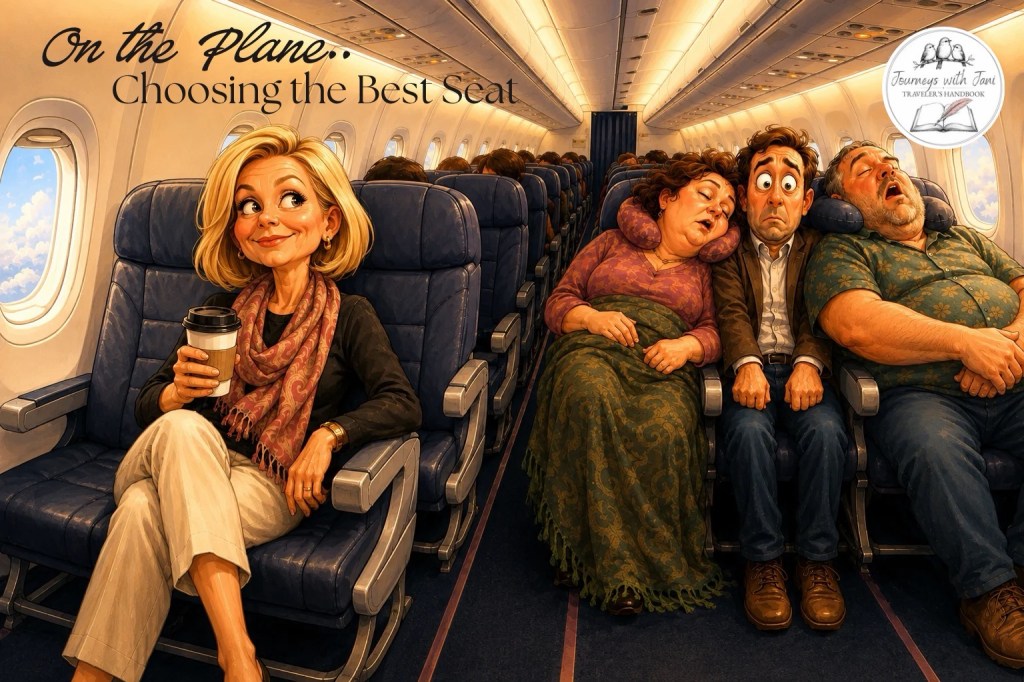
Choosing the Best Seat
In 10 Seconds
There is no best seat on the airplane. There is only the best seat for you, on that airplane, on that trip. The window person and the aisle person will never agree and they shouldn’t have to. What matters is knowing the four or five rows that are quietly awful, knowing which fare classes let you pick at all, and knowing that the seat map you saw at booking is not the seat map that exists at check-in. Pick on purpose and you’ll land in a better mood than the man in 34E.
You’ll learn:
- Why the aisle and window argument is the wrong argument
- The rows that look fine on the map and are not
- Exit row rules, and who is not allowed to sit there no matter how tall they are
- What your fare class actually bought you
- What the rules really say about families sitting together in 2026
- The check-in window where good seats quietly open up
Nobody Wins the Window Versus Aisle Debate
I have watched grown adults, married thirty years, negotiate this like a hostage situation at my desk.
Here is the honest truth. The window seat gives you a wall to lean on, control of the shade, and no one climbing over you. It also means you are trapped. If you are a person who drinks two coffees before boarding and then orders a Diet Coke at cruising altitude, the window seat is not a seat. It is a commitment.
The aisle gives you legroom to lean into, a fast exit, and the freedom to stand up whenever your knees start filing complaints. It also means you will be bumped by the beverage cart, brushed by every human walking to the lavatory, and asked to stand up twice by the window person you are now sharing a life with for the next four hours.
The middle seat gives you both armrests. That is not a consolation prize, that is federal law as far as I’m concerned, and I will defend it.
So the question is not which seat is better. The question is: on this specific flight, what is going to bother me most? A two hour hop to Orlando, take the window and enjoy the view. A red-eye to London, take the window and sleep against the wall. A nine hour flight after too much coffee, take the aisle and thank me later.
Jani’s Tip
Book the aisle and window in a two-seat row, or the aisle and window of a three-seat row when it’s just the two of you. The middle seat is the last one to sell on most flights. If nobody buys it, you’ve got a whole extra seat between you for the price of nothing. If somebody does buy it, they’ll almost always trade for your aisle or window, because nobody chooses a middle seat on purpose. You have not lost a thing.
The Rows That Look Fine and Are Not
The seat map is a diagram. It does not tell you what it’s like to actually sit there. A few to know by heart:
The very last row. It usually doesn’t recline, because there’s a wall behind it. It’s next to the lavatory, which means a line of people standing beside your shoulder for the entire flight, and the door opening and closing and opening and closing. You are also next to the galley, where the crew works, talks, and clangs things. On the upside, you get off the plane last and you’re first for absolutely nothing.
The row in front of the exit row. Frequently doesn’t recline, or barely does, because the exit row behind it has to stay clear. You get all of the last row’s problems with none of the last row’s warning.
Anything within two rows of a lavatory. It’s not the smell so much as the traffic. There is always a person standing right there, weight shifted, waiting, six inches from your headrest.
The bulkhead. This one is genuinely split. You get glorious legroom and nobody reclining into your kneecaps. You also get no seat in front of you, which means no under-seat storage. Everything you own goes in the overhead bin for takeoff and landing, including the book, the snacks, and the headphones you wanted. Bulkhead rows are also where bassinets attach on international flights, so on a long-haul you may find yourself seated next to an infant who did not consent to this either.
Over the wing. This is the smooth spot. The wing is roughly the airplane’s center of gravity, and the ride there is measurably less bumpy than the tail. If turbulence bothers you, or if you get motion sick, this is your row. Window seat over the wing, eyes on the horizon. That combination has saved more stomachs than ginger ale ever did.
Front of the Plane Versus Back, and When It Actually Matters
Sitting up front gets you off the plane faster. That’s the whole benefit, and most of the time it’s worth about eight minutes.
Except when it isn’t. If you have a tight connection, those eight minutes are the entire ballgame. If you’re landing at an airport where you have to clear customs and immigration, being in row 8 instead of row 38 can mean a genuinely shorter line at the passport hall, because the line forms in the order people walk up to it.
The back has one quiet advantage almost nobody uses: the back of the plane is where the empty seats hide. Airlines fill from the front. If the flight isn’t sold out, the last few rows are where you’ll find a whole empty row to stretch across. It’s a gamble, but on an off-peak Tuesday it pays out more often than you’d think.
And a practical one. Overhead bin space runs out from the front, and boarding starts from the back on many carriers. If you’re carrying on and you’re seated in row 30, your bin is usually still wide open when you get there. Row 12 in the last boarding group is where carry-ons go to get gate-checked.
Exit Rows: The Legroom Is Real, the Rules Are Not Optional
Exit row seats are the best legroom deal on a domestic airplane, and they are the ones people ask me about most.
To sit there, federal rules say you must be at least 15 years old, physically able to open a heavy door and help other people out of it, able to read and understand the instructions and crew commands in English, and willing to do all of that. The crew will ask you out loud. “Yes” is the only acceptable answer, and if you’re wearing headphones and you nod without listening, you’re going to get moved.
You also can’t sit there with a lap infant, you can’t have anything at your feet during takeoff and landing, and depending on the row, your seat may not recline at all. Some exit row seats also have the tray table stored in the armrest, which makes the seat itself slightly narrower and the armrests permanently fixed.
Worth it? For a tall person on a long flight, absolutely. For someone flying with a toddler, not an option, and that’s not negotiable.
What Your Fare Class Actually Bought You
This is where people get genuinely blindsided, so let’s be plain about it.
Basic economy on most major U.S. carriers does not include a seat assignment. Not a bad seat. No seat. The computer hands you one after check-in, sometimes not until you’re standing at the gate. On Delta, that fare is now called Main Basic, and your seat isn’t assigned until after you check in. You can usually pay to pick one, which is a fascinating way to discover that the cheap fare was not the cheap fare.
Do the arithmetic before you click. A fifteen dollar seat fee per person per segment, times two people, times a connecting itinerary out and back, is a hundred and twenty dollars. That “savings” of eighty dollars just cost you forty.
Southwest is a different airline than it used to be. As of January 27, 2026, open seating is gone. Southwest now assigns seats, with Standard, Preferred, and Extra Legroom options and group-based boarding. If you haven’t flown them since 2025, throw out everything you knew about lining up at the gate with a laminated A-32.
Jani’s Tip
Before you pay a dime for a seat assignment, go look at the actual aircraft. Airlines fly a dozen different configurations and the same flight number can be a different plane next Tuesday. Seat map sites will show you which “extra legroom” seat is genuinely extra and which one is a normal seat with a misaligned window. That is a free two minutes that has saved my clients a lot of eighty dollar mistakes.
Families Sitting Together: What the Rule Actually Says
Every summer I get the same panicked call. Here is where things stand as of this writing.
There is no federal law requiring airlines to seat you next to your child at no charge. The Department of Transportation proposed one back in 2024. It has not been finalized.
What exists is voluntary. A handful of carriers, including Alaska, American, Frontier, and JetBlue, have formally committed to fee-free adjacent seating for children 13 and under with an accompanying adult. The DOT keeps a dashboard at flightrights.gov showing who has committed and who hasn’t. Delta, United, Southwest, and Allegiant say they will make an effort. “We’ll try” and “we guarantee” are two very different sentences, and you find out which one you bought at the gate.
Even on the airlines that guarantee it, there are conditions. Everyone has to be on the same reservation, and adjacent seats have to be available at the time you book. Adjacent means side by side in the same row, not across the aisle.
So the practical advice is unromantic: book early, book everyone on one reservation, and pick the seats yourself. Do not save twenty dollars and then spend the flight negotiating with a stranger in 22B about whether he’d like to sit next to your six-year-old. He would not.
The Check-In Window Nobody Uses
Here’s the part I want you to actually remember.
The seat map at booking is not the final seat map. At 24 hours out, when check-in opens, the airline processes upgrades. Elite passengers get pulled out of economy and moved to first class. Every one of those moves leaves an empty seat behind, and a lot of them are the good ones: aisle seats, exit rows, the front of the cabin.
So set an alarm for exactly 24 hours before departure, check in, and then go look at the seat map again. Then look one more time at the airport. I have moved more clients into better seats in that window than in any other way, and it costs nothing but attention.
And if you’re stuck in a seat you hate, ask the gate agent. Politely, briefly, and not while they’re boarding the plane. Go up when the podium is quiet, say you’re hoping for an aisle if anything opens up, and thank them either way. Gate agents have moved mountains for people who were kind to them and have moved absolutely no one for people who were not.
Jani’s Quick Reference
- Motion sick or nervous flyer: over the wing, window
- Tight connection or customs on arrival: as far forward as you can get
- Tall: exit row or bulkhead aisle, check the recline before you commit
- Sleeping on a red-eye: window, forward of the wing, away from the lavatory
- Carrying on and boarding last: farther back means your bin is still empty
- Traveling with kids: one reservation, seats picked at booking, no exceptions
One Last Thing…
A seat assignment seems like a small thing right up until you’re wedged in a middle seat in the back row, next to the lavatory, on a five hour flight, wondering how it happened. It happened at booking, when somebody clicked the cheapest fare and moved on.
This is the sort of detail I handle for clients without being asked, because I already know which fare classes come with a seat and which ones come with a surprise, and because I’ve flown enough of these airplanes to know that row 12 on one carrier is not row 12 on another. When you’re ready to plan the trip and you’d rather not spend your evening squinting at a seat map, let’s plan it together. I’ll get you in a seat you can live with.
One page at a time, we’re building a smarter way to travel.
XOXO, Jani ~ Personal Travel Advisor | Take Time To Travel, LLC
Updated August 2026
Seat fees, fare class rules, and family seating policies vary by airline and change frequently. Always confirm current seating policies with your airline before you book.
Related Traveler’s Handbook Articles
Airport Know-How
People Ask Me This Every Single Week
Before You Go
- Carry On vs. Checked Bag
- Travel Documents You Should Always Carry
- Travel Apps Worth Downloading Before You Leave
- Travel Insurance Explained
Hotels & Resorts


Leave a Reply